
Summer storms here run on a schedule. From June to September 2016-2025, St. Pete-Clearwater International Airport (PIE) reported thunder on 64% of days, yet 79% of days had none between 6 a.m. and 1 p.m. The odds peak from 2 to 6 p.m., at about 1 day in 4, and a typical rainy day had rain in just 2 hourly reports. Hit the beach early, plan indoor time mid-afternoon, and come back out for sunset.
Key takeaways
- “Rain every day” in a summer forecast usually means a chance of an afternoon storm. Measurable rain fell at PIE on 51% of June-to-September days, and only about 1 day in 15 had rain in six or more hourly reports.
- Mornings are the safe bet. Thunder was reported between 6 and 8 a.m. on 3% of summer days and between 8 and 10 a.m. on 6%.
- The storm window opens around noon and stays open until about 8 p.m. The worst single slot is 4 to 6 p.m. in August, when thunder was reported on 35% of days.
- July (77% of days with thunder) and August (74%) are the stormiest months. June (59%) and September (46%) are calmer. From November through March, it's 3% to 6%, which is one reason to look at Clearwater Beach in winter if storms worry you.
- Storms tend to be short. On 70% of thunder days, thunder showed up in three or fewer clock hours, and when it thundered between 4 and 8 p.m., about 7 in 10 of those evenings were quiet again after 8.
- Lifeguards work 10 a.m. to 5 p.m. (as of October 2026), so they go off duty in the middle of the stormiest hours. After 5, deciding when to get out of the water is up to you. The National Weather Service rule: if you hear thunder, go indoors, and stay there until 30 minutes after the last rumble.
Does it really rain every day at Clearwater Beach in summer?
No, though the forecast makes it look that way. From June through September, most weather apps put a storm icon on nearly every day of a week-long trip. That icon stands for a chance of rain, not a washout. The National Weather Service defines the probability of precipitation as the chance that a given point gets at least 0.01 inch of rain during the forecast period. A 40% chance on a July Tuesday means a decent shot at a shower at some point, not 40% of the day spent in the rain.
To put real numbers on it, we pulled every weather report from the automated station at PIE for June through September of 2016 through 2025: 1,218 days of hourly reports, plus the special reports the station sends whenever a thunderstorm starts or ends. Ten summers of those reports show:
- Thunder on 64% of summer days (782 of 1,218). That counts lightning anywhere within 10 miles of the airport, which is a wide net.
- Measurable rain at the airport on 51% of days. Many thunder reports were for storms in the vicinity, and the station itself often stayed dry.
- When it did rain, it didn't rain long. Rainy days had a median of 2 hourly reports with measurable rain, and 72% of them had 3 or fewer.
- All-day rain was rare. Only 6.5% of summer days had measurable rain in six or more hourly reports, about 8 days in a typical four-month summer.
The pattern is hot, humid mornings, a good chance of a thunderstorm somewhere in the area from early afternoon to early evening, and usually a clear-out before dark. NOAA's JetStream sea breeze explainer describes the engine. Land heats faster than the water, cooler sea air pushes inland underneath the warm air, and thunderstorms often develop along that sea-breeze front. If you want temperatures and monthly rain totals, our Clearwater Beach weather by month guide has them. This page sticks to timing.
What time do summer thunderstorms hit Clearwater Beach?
Mostly mid-afternoon to early evening. Each cell in our storm clock below is the share of days on which the PIE station reported thunder at least once during that two-hour window, in local Eastern Daylight Time. Read it like a betting line: a 25% cell means thunder somewhere in that window on about 1 day in 4.
| Time of day (EDT) | June | July | August | September | All summer |
|---|---|---|---|---|---|
| Midnight to 6 a.m. | 7% | 9% | 11% | 4% | 8% |
| 6 to 8 a.m. | 2% | 4% | 5% | 2% | 3% |
| 8 to 10 a.m. | 6% | 8% | 8% | 2% | 6% |
| 10 a.m. to noon | 9% | 15% | 12% | 6% | 10% |
| Noon to 2 p.m. | 15% | 30% | 23% | 11% | 20% |
| 2 to 4 p.m. | 19% | 32% | 32% | 19% | 26% |
| 4 to 6 p.m. | 21% | 26% | 35% | 18% | 25% |
| 6 to 8 p.m. | 21% | 27% | 27% | 18% | 23% |
| 8 to 10 p.m. | 14% | 18% | 12% | 7% | 13% |
| 10 p.m. to midnight | 7% | 10% | 6% | 4% | 7% |
| Any time that day | 59% | 77% | 74% | 46% | 64% |
Bold cells are the peak for each column. Source: our analysis of Iowa Environmental Mesonet ASOS observations for PIE, June 1 to September 30, 2016-2025. Rows don't add up to the daily total because a single storm often spans two or more windows.
Mornings are nearly storm-free. From 6 to 10 a.m., the thunder odds stay in single digits in every month.
The window doesn't shut at 4 p.m. The odds hold near their peak until 8, and the single worst clock hour across the four months is the 3 p.m. hour, with thunder on 18% of days.
July runs early. On July thunder days the median first rumble came in the 1 p.m. hour, an hour ahead of June, August and September, and July is the only month where the noon-to-2 p.m. window reaches 30%. In July, trim “beach until 2” to “beach until noon or 1.”
Nights aren't storm-free either. August had thunder between midnight and 6 a.m. on 11% of days, the most of the four summer months. That matters for night fishing and late beach walks more than for a typical beach day.
Data: every routine and special weather report (METAR and SPECI) from the automated surface observing system at St. Pete-Clearwater International Airport (station PIE), downloaded from the Iowa Environmental Mesonet ASOS archive with timestamps in America/New_York time. Dates: June 1 to September 30, 2016 through 2025, 1,218 days (we dropped one day with an incomplete record, and one more is missing from the archive). Retrieved October 4, 2026.
Thunder rule: a day-window counts if any report in it carried a thunderstorm weather code (TS, -TSRA, TSRA, +TSRA or VCTS). Under the lightning rules in the ASOS User's Guide, the system reports “TS” when lightning strikes are occurring within 5 miles and “VCTS” when they are between 5 and 10 miles away. Rain rule: an hour counts if the routine hourly report (issued at 53 minutes past the hour) recorded at least 0.01 inch. Traces don't count. Heat index is the median of the values the Mesonet computes for those routine reports.
Caveat: PIE sits on the shore of Old Tampa Bay, about 10 miles east of Pier 60 in a straight line. No station on the beach itself keeps a comparable thunder record, so treat these as odds for the area, not a forecast for your patch of sand. Storms that form along the sea breeze can hit the airport and miss the beach, and the reverse.
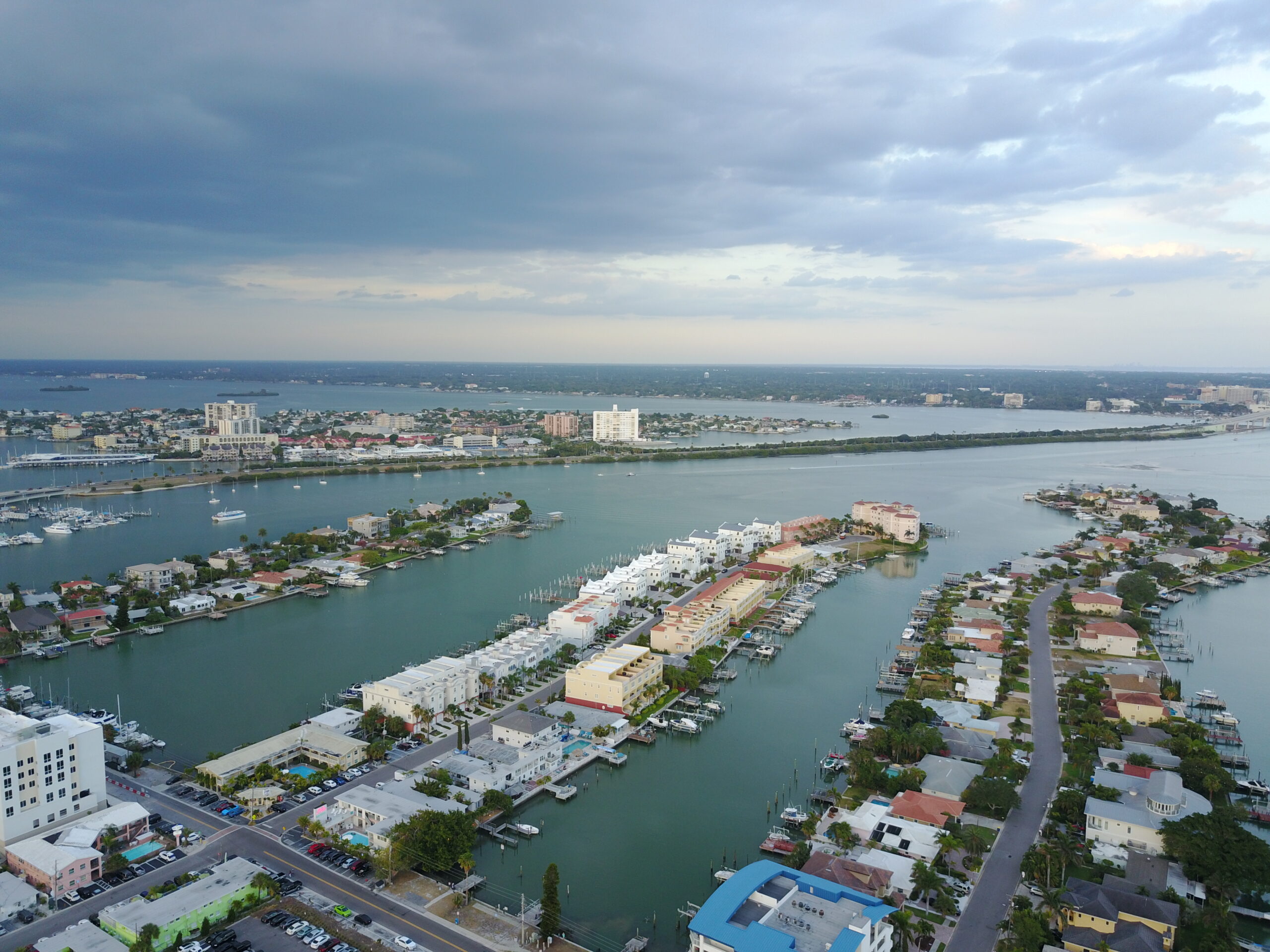
How should you plan a summer beach day around the storms?
Treat the storm clock as a schedule. This plan follows the odds, and the heat lines up with it.
- Beach from early morning to about 1 p.m. On 79% of summer days, PIE reported no thunder at all between 6 a.m. and 1 p.m. The sun is up by about 6:35 a.m. in June and 7:10 a.m. by September 1, so an 8 a.m. start still gives you five hours on the sand. Our best time of day to visit guide covers parking and crowds for the same hours.
- From about 1 to 6 p.m., stay close to a roof. Long lunch, nap, hotel pool (an outdoor pool is still outside, so get out when it thunders). Our rainy day guide lists indoor options. You don't have to hide all afternoon: PIE reported thunder between 1 and 6 p.m. on 44% of summer days (55% in July and August, 36% in June, 31% in September). Watch the sky, the radar and the live beach cams, and stay within a short walk of shelter.
- Back out for sunset. On 79% of summer days, PIE reported no thunder between 7 and 10 p.m. Sunset falls around 8:30 p.m. from mid-June to mid-July and about 7:50 p.m. by September 1. Our sunset times table has exact times for every half-month.
The airport's median heat index (the “feels like” temperature) sits in the upper 70s to upper 80s just before 8 a.m. and reaches the high 90s, or 100°F in August, by early afternoon.
| Report time (EDT) | June | July | August | September |
|---|---|---|---|---|
| 7:53 a.m. | 85°F | 88°F | 87°F | 79°F |
| 9:53 a.m. | 92°F | 95°F | 95°F | 89°F |
| 11:53 a.m. | 95°F | 98°F | 99°F | 95°F |
| 1:53 p.m. | 96°F | 99°F | 100°F | 97°F |
| 3:53 p.m. | 97°F | 99°F | 100°F | 97°F |
| 5:53 p.m. | 95°F | 98°F | 98°F | 94°F |
| 7:53 p.m. | 90°F | 93°F | 93°F | 89°F |
| 9:53 p.m. | 86°F | 89°F | 89°F | 87°F |
Median of the hourly heat-index values the Iowa Environmental Mesonet computes from PIE temperature and dew point, June to September 2016-2025. Half the days ran hotter. PIE sits on Old Tampa Bay, not the Gulf, so a sea breeze on the sand may feel different, but no beach station offers 10 years of comparable data.
The City of Clearwater says its lifeguards are on duty seven days a week from 10 a.m. to 5 p.m. (as of October 2026). The storm clock's busiest stretch runs from 2 to 8 p.m., so half of it falls after the towers close. Swim after 5 on a summer afternoon and nobody official is watching the sky for you.
Is June, July, August or September the stormiest month?
July and August, by a wide margin. June and September are calmer in different ways: June's afternoon odds sit well below July's and August's, and September has the fewest thunder days of the four but falls in the heart of hurricane season (more on that below).
| Month | Days with thunder within 10 mi | Within 5 mi | Days with measurable rain at PIE | Days with rain in 6+ hourly reports |
|---|---|---|---|---|
| June | 59% | 44% | 47% | 5% |
| July | 77% | 57% | 55% | 7% |
| August | 74% | 54% | 57% | 8% |
| September | 46% | 34% | 44% | 6% |
| June to September | 64% | 48% | 51% | 6.5% |
Same PIE data and method as the storm clock. For contrast, thunder was reported on 13% of April days, 19% of May days and 11% of October days, and on only 3% to 6% of days from November through March. May to June is the biggest jump of the year.
The “within 5 miles” column is the stricter count, and even by that measure more than half of July and August days had a storm close by at some point. If you're worried about a ruined trip, look at the last column instead. It stays small all summer, from about 1 day in 20 in June to about 1 day in 12 in August.
Summers vary, too. The June-to-September share of thunder days ranged from 55% in 2023 to 78% in 2018, so one stormy week tells you little about the next.
Our verdict by month:
- June: the easiest summer month for beach time. No two-hour window tops 21%.
- July: the stormiest month, and the earliest. Plan to be off the sand by about 1 p.m. on most days.
- August: nearly as stormy as July, with the hottest afternoons and the single highest-odds slot (4 to 6 p.m., 35%). Mornings are still good.
- September: the fewest thunder days and the coolest mornings of the four. Book flexibly because of tropical weather.
How long do summer storms last?
A few hours at most, usually. Across the 782 summer days with thunder at PIE:
- Thunder was reported in a median of 3 clock hours per thunder day. On 45% of those days it was 2 hours or fewer, and on 95% it was 6 or fewer. (A “clock hour” counts if any report during it mentioned thunder, so a storm that straddles 4 p.m. can count as two hours.)
- The first thunder usually came after lunch. On the median thunder day, the first report fell in the 2 p.m. hour. On 61% of thunder days, the first thunder came at 1 p.m. or later.
- Evenings usually cleared. Of the 441 days with thunder between 4 and 8 p.m., 70% had no thunder at all after 8 p.m.
So when the sky darkens at 3 p.m., don't cancel dinner plans. Odds are it means a long late lunch indoors, then a dry evening.
What should you do when you hear thunder at the beach?
Get out of the water, off the sand and indoors. The National Weather Service puts it bluntly: “When thunder roars, go indoors.” If you can hear thunder, you are likely within striking distance, and there is no safe place outside when thunderstorms are in the area. Stay in safe shelter for at least 30 minutes after the last thunder you hear. The City of Clearwater's beach rules page uses the same slogan and tells visitors to stay out of the water and off the beach when lightning is present.
Shelter means less than you might think. The NWS defines safe shelter as a substantial building with electricity or plumbing, or an enclosed, metal-topped vehicle with the windows up. A beach umbrella, a rented cabana and the shade under a palm tree are none of those. Near Pier 60, that leaves the enclosed hotels, restaurants and shops along the Beach Walk and Mandalay Avenue, or your car if it's parked close by.
Two points from the data:
- The ASOS sensor at PIE reports “thunderstorm in the vicinity” for lightning 5 to 10 miles away. A storm that looks distant over the bay can still be close enough to matter.
- Afternoon thunder days far outnumber all-day washouts. Waiting 30 minutes indoors costs you a half hour, not the afternoon.
Lifeguards fly beach warning flags at their towers, and the city says towers are staffed based on season and weather. We found no published lifeguard lightning procedure on the city's site, so don't wait for a whistle. Our Clearwater Beach lifeguards guide covers tower locations and flag colors.
Official guidance: National Weather Service lightning safety and NWS lightning safety tips.
How much does hurricane season overlap a summer trip?
All of it. According to the National Hurricane Center, the Atlantic hurricane season runs from June 1 to November 30, peaks around September 10, and sees most of its activity between mid-August and mid-October. The storm clock above measures everyday afternoon thunderstorms, a different animal. September's lower thunder count doesn't make it the low-risk month for tropical weather. It's the opposite.
For a late-summer trip, book refundable where you can, look at travel insurance before a storm is named, and keep an eye on the NHC outlook in the week before you leave. Our hurricane season guide for Clearwater Beach covers peak risk months, travel insurance, and what to do if a storm is forecast during your trip.
What else changes on the beach in summer?
Summer is sea turtle nesting season. The Clearwater Marine Aquarium, which patrols about 21 miles of North Pinellas beaches, says the season runs from May 1 through October 31, and most local nests are loggerheads. The City of Clearwater asks beachgoers to:
- Fill in any holes you dig and knock down sandcastles before you leave.
- Keep flashlights and phone lights off on the beach at night.
- Leave turtles and hatchlings alone, and never touch or disturb a nest.
- Pack out your trash, especially plastic bags.
- Report an injured turtle to the FWC Wildlife Alert Hotline at (888) 404-3922.
The lights-off rule is the one most visitors run into, since it covers the same clear evenings the storm clock favors. Our sea turtle season guide has more on the season and the rules.
Warm water changes a few other things. CDC says Vibrio bacteria are found in higher numbers from May through October, so read up on Vibrio season in the warm Gulf before you swim with a fresh cut. When you wade, slide your feet with the stingray shuffle the city recommends. Calm sunsets bring biting midges and mosquitoes too, and our bug guide shows which months have the most calm, buggy evenings. Away from the Gulf, summer bioluminescence in Old Tampa Bay peaks in July and August in bloom years, though recent summers have been quiet.
When are the low tides on summer evenings?
From June through August, the lowest tides of the month fall in the late afternoon and evening, right in the post-storm window. We pulled NOAA's tide predictions for the Clearwater Beach station (8726724) for June through September 2027. All 36 low tides predicted below zero feet (mean lower low water) fall between about 4 and 10 p.m. local time, and September has none. The three deepest runs:
| Dates (2027) | Evening low tide time | Predicted height (ft, MLLW) |
|---|---|---|
| Thu Jun 3 to Sun Jun 6 | 6:04 to 8:27 p.m. | -0.68 to -0.88 |
| Fri Jul 2 to Mon Jul 5 | 5:55 to 8:11 p.m. | -0.60 to -0.82 |
| Sat Jul 31 to Sun Aug 1 | 5:41 to 6:25 p.m. | -0.52 to -0.53 |
NOAA CO-OPS high/low predictions, retrieved October 4, 2026. Predictions are astronomical, and wind can push the water higher or lower than forecast. On the Fourth of July 2027, the predicted low is -0.78 feet at 7:27 p.m., about an hour before the 8:32 p.m. sunset. Low evening tides are good for sandbar walks and shelling on a negative low tide, but they land in the 6-to-8 p.m. window, when thunder still shows up on nearly 1 day in 4, so check the radar before you wade out. Our Clearwater Beach tides guide covers tide timing in more detail.
The storm clock, month table, storm-length figures and heat-index table are our own analysis of public weather records: PIE airport observations from the Iowa Environmental Mesonet ASOS archive (2016-2025), with thunderstorm codes defined by the NWS ASOS User's Guide. Tide times come from NOAA CO-OPS predictions and sunrise and sunset times from the U.S. Naval Observatory. Safety guidance comes from the National Weather Service and the City of Clearwater, hurricane season dates from the National Hurricane Center, and sea turtle season details from the Clearwater Marine Aquarium and the City of Clearwater. All were checked in October 2026. We didn't stand on the beach and time storms. Our script and results are saved so the numbers can be re-run. We're an independent guide, and nobody named here pays us.
Frequently asked questions
Is Clearwater Beach worth visiting in August?
Yes, if you plan around the afternoons. August had thunder near the airport on 74% of days from 2016 to 2025, and 4 to 6 p.m. was the worst slot of the summer (35% of days). But thunder between 6 and 10 a.m. was rare, and only about 8% of August days had rain in six or more hourly reports. Expect a heat index near 100°F in the afternoon, and watch the tropics, since August leads into the peak of hurricane season.
Do summer storms in Clearwater last all day?
Rarely. On summer thunder days, thunder was reported in a median of 3 clock hours, and 70% of days with thunder between 4 and 8 p.m. were quiet again after 8 p.m. Only 6.5% of June-to-September days had measurable rain in six or more hourly reports at the airport.
What time do storms usually start in Clearwater in summer?
On the median thunder day, the first thunder came in the 2 p.m. hour, and on 61% of thunder days it started at 1 p.m. or later. July runs earliest: the noon-to-2 p.m. window had thunder on 30% of July days.
Will afternoon storms delay my flight?
They can. The storm clock comes from the weather station at St. Pete-Clearwater International itself, and thunder there is least likely in the morning (3% of summer days between 6 and 8 a.m.) and most likely between 2 and 6 p.m. If you can choose, a morning departure faces lower storm odds at PIE. Tampa International is a different airport with its own weather, and our TPA vs PIE comparison covers the other trade-offs. Check your airline's app and the FAA's National Airspace System status page on travel day.
Is it safe to swim in the Gulf when it's thundering?
No. The National Weather Service says no place outside is safe when thunderstorms are in the area, and the City of Clearwater tells visitors to stay out of the water and off the beach when lightning is present. Go into a building or a hard-topped car and wait at least 30 minutes after the last thunder.
Which summer month has the fewest storms?
September, with thunder on 46% of days, followed by June at 59%. But September sits at the height of hurricane season, which peaks around September 10, while June carries less tropical risk. If you want few storms of both kinds, June is the better bet.
Sources
- Iowa Environmental Mesonet, ASOS/AWOS data download, station PIE (St. Pete-Clearwater International), June-September 2016-2025, America/New_York timestamps, retrieved October 4, 2026. mesonet.agron.iastate.edu
- National Weather Service, ASOS User's Guide, section 4.3 (TS within 5 miles, VCTS 5 to 10 miles; SPECI at start and end of a thunderstorm). weather.gov
- National Weather Service, Lightning Safety (“When Thunder Roars, Go Indoors”). weather.gov
- National Weather Service, Lightning Safety Tips and Resources (safe shelter, 30 minutes after last thunder). weather.gov
- National Weather Service Peachtree City office, probability of precipitation (PoP) explainer. weather.gov
- NOAA JetStream, The Sea Breeze. noaa.gov
- City of Clearwater, Clearwater Beach Rules & Information (lifeguard hours, lightning guidance, flags). myclearwater.com
- City of Clearwater, Sea Turtle Nesting Season (beachgoer guidance, FWC hotline). myclearwater.com
- Clearwater Marine Aquarium, Conservation and Research (nesting season May 1 to October 31, North Pinellas patrols). cmaquarium.org
- National Hurricane Center, Tropical Cyclone Climatology (season dates and peak). nhc.noaa.gov
- NOAA CO-OPS, tide predictions for Clearwater Beach, FL (station 8726724), June-September 2027, retrieved October 4, 2026. tidesandcurrents.noaa.gov
- U.S. Naval Observatory, Complete Sun and Moon Data for One Day (27.9775° N, 82.8285° W, summer 2027 dates). aa.usno.navy.mil
Planning a summer trip to Clearwater Beach?
Mornings on the sand, afternoons under a roof, evenings back outside. Build the rest of the trip around that.
Plan your visit