
Yes, stingrays live in the Clearwater Beach shallows, and the City of Clearwater's advice is simple: shuffle your feet so they swim off. If you're stung, soak the wound in hot water (104 to 113°F) and see a lifeguard (on duty 10 a.m. to 5 p.m. daily) or a doctor. Sharks are a much smaller worry: the Florida Museum's shark file lists 13 confirmed unprovoked bites in Pinellas County since 1882, against 303 in Volusia County alone.
Key takeaways
- Stingrays lie partly buried in shallow sand and sting in self-defense, usually when someone steps on them. The city's fix is the "stingray shuffle": slide your feet from the moment you enter the water until you leave.
- MedlinePlus (National Library of Medicine) first aid: get out of the water, control bleeding, then soak the wound in 104 to 113°F water for 30 to 90 minutes. Get medical help too; some stings need professional care.
- A purple flag means stinging marine life: man o' war, jellyfish or stingrays. Guards post flags from their towers, and they're on duty 10 a.m. to 5 p.m. daily.
- Pinellas County accounts for 13 of Florida's 828 confirmed unprovoked shark bites in the International Shark Attack File, about 1.6 percent. None of Florida's 11 bites in 2025 were in Pinellas.
- FWC says Florida shark activity peaks April through October. Even so, you're about 30 times more likely to be struck by lightning in Florida than bitten by a shark.
Are there stingrays at Clearwater Beach?
Yes. The City of Clearwater covers them on its beach rules page, and Florida's wildlife agency (FWC) profiles several stingray species that live along beaches, bays and sand flats like the ones off Clearwater Beach. Rays feed on the bottom and often lie partly buried in the sand, so you usually don't see one until your foot is on top of it.
They don't go after people. FWC calls these species non-aggressive, with one catch: a defensive venomous barb near the base of the tail. The city's wording is that stingrays "will defend themselves if they feel that they are threatened, such as being stepped on." A bare foot landing on a buried ray is the classic sting.
| Species (FWC) | Where FWC says it lives | Wingspan |
|---|---|---|
| Atlantic stingray | Coastal waters, estuaries and lagoons; tolerates low salinity | Wingspan up to about 2 feet |
| Bluntnose stingray | Ocean beaches, bays, estuaries and river mouths, usually in shallow water | Up to about 3 feet |
| Southern stingray | Ocean beaches, bays, estuaries and river mouths; grass and sand or mud flats | 4 to 5 feet (up to about 200 pounds) |
| Yellow stingray | Sandy beaches right to the water's edge, and sand around reefs | Up to about 14 inches |
FWC gives the same advice for each: do the stingray shuffle, and avoid handling them. If you hook one while fishing from Pier 60, cut the line instead of grabbing the ray. For what else lives in the shallows, month by month, see our Clearwater Beach wildlife calendar.
When are stingrays most common at Clearwater Beach?
No agency publishes a "stingray season" for Clearwater Beach. Not the city, not FWC. Water temperature is the better guide. The Florida Museum's Atlantic stingray profile says the species prefers water above 59°F and, in parts of its range, moves from shallow to deeper water in winter.
NOAA's long-term monthly averages for its Clearwater Beach station show the Gulf here rarely gets that cold:
| Months | NOAA average water temp, Clearwater Beach | What that means for wading |
|---|---|---|
| Dec to Feb | 65.2°F (Dec), 61.5°F (Jan), 63.5°F (Feb) | Coolest water, fewest people in it. Shuffle anyway. |
| Mar to Apr | 69.2°F, 74.8°F | Water warms fast and spring-break crowds arrive |
| May to Sep | 81.5°F to 87.8°F | Warmest water and the most people wading. Highest exposure. |
| Oct to Nov | 79.2°F, 70.9°F | Still warm in October, cooling through November |
Our read of those two sources: rays can be in the shallows any month, because even January averages above 59°F. The odds of stepping on one run highest from late spring through early fall, mostly because that's when the most people are wading. Shuffle year-round. Monthly detail is on our Clearwater Beach water temperature page.
How do you do the stingray shuffle?
The City of Clearwater's instruction is to "shuffle or slide your feet slowly through the sand to warn the stingrays of your presence, and they will move out of your way," and to keep doing it "from the time you get in the water until the time you get out." What that looks like:
- Slide, don't step. Keep your feet on the bottom and push them forward through the sand. A ray that feels the vibration swims off; one that gets stepped on swings its tail.
- Keep it up the whole time you're standing. Most people shuffle on the way in and forget once they stop to talk in waist-deep water. If your feet touch bottom, slide them.
- Teach the kids first. Running and jumping into the shallows is exactly how a foot comes down on a buried ray.
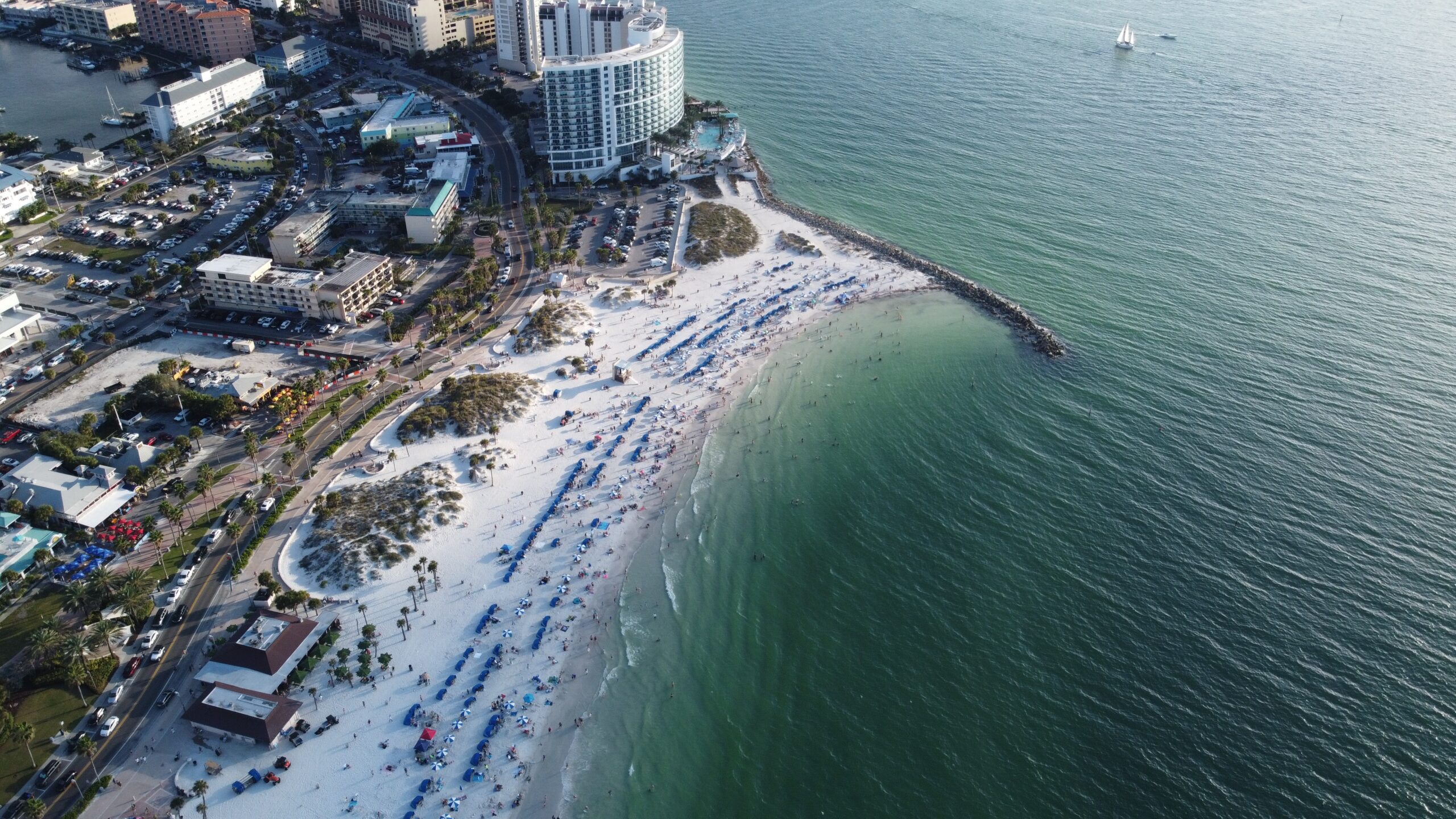
- Swim in front of a staffed tower. City lifeguards are on duty 10 a.m. to 5 p.m. daily, year-round. Our lifeguard guide covers where the towers are.
What should you do if a stingray stings you?
Call 911 for trouble breathing, fainting, heavy bleeding, or a sting to the chest, abdomen or neck. MedlinePlus warns a puncture to the chest or abdomen can be life-threatening. For any sting, the City of Clearwater says to see a lifeguard or go to a nearby fire station for an assessment, and FWC says most stingray injuries need immediate medical attention.
Expect severe pain at the sting site, often with swelling and bleeding. The steps below follow MedlinePlus guidance for a superficial sting to an arm or leg, done while you wait for medical help:
- Get out of the water and onto the sand. Wave down the nearest staffed tower if one is in sight.
- Control any bleeding with direct pressure using a clean cloth or bandage.
- Soak the wound in hot water, 104 to 113°F (40 to 45°C). No thermometer? Use water as hot as the person can comfortably tolerate on an unaffected limb, since the stung area may be numb or too painful to judge. Soak for at least 30 minutes and no longer than 90, checking the water stays hot.
- Wash gently with mild soap and clean water to clear debris and venom.
- Apply antibiotic ointment if not allergic, and cover with a sterile non-stick dressing.
- Get it checked. MedlinePlus says to seek medical help right away. Deep stinger penetration can require surgery to remove, and numbness or tingling can last for weeks.
Not sure what to do? The Poison Help line, 1-800-222-1222, is free, confidential and open 24 hours a day. Hospitals and urgent care near the beach are listed on our emergency numbers page.
| Where to get help | Details (as of October 2026) |
|---|---|
| Emergency | Call 911 |
| Lifeguard headquarters (Tower 0) | 180 S. Gulfview Blvd., (727) 444-8580. Guards on duty 10 a.m. to 5 p.m. daily |
| Clearwater Fire & Rescue Station 46 | 546 Mandalay Ave., (727) 562-4334. The fire and advanced life support station for the beach. The city's advice is to go to a nearby fire station to have a sting assessed |
| Poison Help line | 1-800-222-1222, free, 24/7 |
What does a purple flag mean at Clearwater Beach?
Purple means stinging marine life. The Florida Department of Environmental Protection's beach warning flag sign spells it out: "Man o' War, Jellyfish, Stingrays." The other colors rate surf and currents; purple is about what's living in the water.
The city says flags are displayed on the beach and on top of lifeguard towers, warns that "water conditions can change quickly," and suggests asking a guard if you're unsure. Two things catch visitors out. Before 10 a.m. and after 5 p.m. no guards are on duty to update the flags, and the state sign says plainly that the "absence of flags does not assure safe waters." And a day without a purple flag isn't a day without rays. Shuffle either way.
To check the flag before you leave your hotel, see our Clearwater Beach flag today guide. If purple is up for jellyfish, our jellyfish guide covers identification and sting care, which differs from stingray first aid.
Are there sharks at Clearwater Beach, and do they bite?
Yes, sharks live in the Gulf off Clearwater Beach, as they do off every Florida beach. FWC describes the bonnethead, the smallest hammerhead at about 3.5 feet, as abundant in nearshore Florida waters, common over shallow sand and mud flats, and harmless to humans. The blacktip is common in Florida's coastal waters, bays and estuaries and has been implicated in attacks on bathers. The Florida Museum suspects blacktips account for most of Florida's bites by requiem sharks, a group whose species are hard to tell apart after a bite.
Bites around Clearwater are rare. The Florida Museum's International Shark Attack File (ISAF), the standard record, maps confirmed unprovoked bites by county back to 1882. These totals come from its data file last updated in June 2026:
| Area | Confirmed unprovoked bites, 1882 to present (ISAF) |
|---|---|
| Pinellas County (Clearwater Beach, St. Pete Beach) | 13 |
| Lee County (Fort Myers Beach, Sanibel) | 8 |
| Sarasota County (Siesta Key) | 7 |
| Brevard County (Cocoa Beach) | 147 |
| Volusia County (Daytona, New Smyrna Beach) | 303 |
| Florida, all counties | 828 |
Thirteen bites in more than 140 years. Volusia County logged 17 in 2021 alone. In 2025, ISAF counted 11 unprovoked bites in Florida, none fatal: six in Volusia, two each in Broward and Lee, one in Miami-Dade. That was below the state's recent five-year average of 19 a year.
FWC's numbers point the same way. Shark activity in Florida peaks April through October, which is also when the most people are swimming. Florida bites are fatal less than 1 percent of the time. And you're about 30 times more likely to be struck by lightning in Florida than bitten by a shark, so a summer afternoon thunderstorm is the bigger threat on most beach days.
Swim in groups and in areas with lifeguards. Stay out of the water at twilight and after dark. Keep away from people fishing, including the water around Pier 60, and from places where baitfish are jumping or seabirds are diving. Skip shiny jewelry, don't swim with an open wound, and get out if a shark is sighted.
What else in the water can sting or bite?
- Jellyfish and Portuguese man o' war. Both are on the state's purple-flag sign. FWC warns that jellyfish washed up on the sand can still sting, so don't let kids pick them up. Details are in our jellyfish guide.
- Hardhead catfish. FWC describes three sharp spines (one on the dorsal fin, one on each pectoral fin) and says the fish is commonly caught from piers, including the piers around Clearwater. Watch your step around any catfish left on the sand or a pier deck.
- Sharks drawn by fishing. Bait and hooked fish attract sharks, which is part of why FWC advises staying away from areas used for fishing.
For the bigger picture on swimming conditions, crime and rip currents, see Is Clearwater Beach safe?
Compiled from the City of Clearwater's beach safety and fire station pages, FWC's shark and ray species pages, the Florida Museum's International Shark Attack File county data and 2025 summary, NOAA's coastal water temperature guide, the Florida DEP beach warning flag sign and the National Library of Medicine's MedlinePlus, all listed below and checked October 2026. We did not interview lifeguards or doctors for this page. We are an independent guide and are not paid by any business named here.
Frequently asked questions
Is there a stingray season at Clearwater Beach?
No official one. Stingrays follow water temperature, and NOAA's monthly averages for Clearwater Beach stay above the 59°F the Florida Museum gives as the Atlantic stingray's preference even in January. Expect rays any month. The most stings are likely from late spring through early fall, when the most people are wading.
Does the stingray shuffle actually work?
It's the method the City of Clearwater and FWC both recommend. Sliding your feet warns a buried ray so it swims off instead of getting stepped on, and the city names being stepped on as the reason rays sting.
Should I use vinegar on a stingray sting?
Vinegar is a jellyfish remedy. For stingrays, MedlinePlus guidance is hot water: soak the wound at 104 to 113°F for 30 to 90 minutes, then wash it, apply antibiotic ointment and cover it while you get medical help.
Can I swim when the purple flag is up?
Purple warns that stinging marine life is present. It doesn't close the water; only a double red flag does that. Ask the lifeguard on duty what they've seen, shuffle your feet, and stay out if you're with small children or have had a bad reaction to a sting before.
Has anyone been killed by a shark at Clearwater Beach?
The Florida Museum's public county data gives totals, not individual case outcomes, so we can't confirm that from the record. What it does show is 13 confirmed unprovoked bites in all of Pinellas County since 1882, and FWC says Florida shark bites are fatal less than 1 percent of the time.
Are there lifeguards to help if I get stung?
Yes, from 10 a.m. to 5 p.m. every day. Lifeguard headquarters is Tower 0, 180 S. Gulfview Blvd. The city also says stung swimmers can go to a nearby fire station for an assessment; Station 46 is at 546 Mandalay Ave. For anything serious, call 911.
Sources
- City of Clearwater, Clearwater Beach Rules & Information (stingrays, beach warning flags, lifeguard hours, fire station assessment). myclearwater.com
- City of Clearwater, Tower 0 lifeguard headquarters (address, phone, staffing). myclearwater.com
- City of Clearwater, Fire Station 46 (address, phone, beach response equipment). myclearwater.com
- Florida Museum of Natural History, International Shark Attack File, Florida county map of confirmed unprovoked attacks, 1882 to present (data file updated June 2026; checked October 2026). floridamuseum.ufl.edu
- Florida Museum of Natural History, International Shark Attack File, Yearly Worldwide Shark Attack Summary (2025). floridamuseum.ufl.edu
- Florida Museum of Natural History, Discover Fishes, Atlantic stingray profile (temperature preference and seasonal movement). floridamuseum.ufl.edu
- Florida Fish and Wildlife Conservation Commission, Ray Species (Atlantic, bluntnose, southern and yellow stingray profiles; stingray sting note). myfwc.com
- Florida Fish and Wildlife Conservation Commission, Sharing the Water with Sharks: Awareness and Education are Key. myfwc.com
- Florida Fish and Wildlife Conservation Commission, Reducing the Odds of a Shark Bite. myfwc.com
- Florida Fish and Wildlife Conservation Commission, Blacktip Shark and Bonnethead Shark profiles. myfwc.com
- Florida Fish and Wildlife Conservation Commission, Jellyfish and Hardhead Catfish profiles. myfwc.com (jellyfish), myfwc.com (hardhead catfish)
- Florida Department of Environmental Protection, Beach Warning Flags sign (2024). floridadep.gov (PDF)
- NOAA National Centers for Environmental Information, Coastal Water Temperature Guide, Clearwater Beach, FL monthly averages. ncei.noaa.gov
- U.S. National Library of Medicine, MedlinePlus, Stingray. medlineplus.gov
Heading into the water?
Check today's flag, set up near a staffed tower, and shuffle your feet from the first step.
Check today's flag