
Vibrio vulnificus infections are real but rare. The Florida Department of Health counted 33 cases and 5 deaths statewide in 2025, and 25 cases and 5 deaths in 2026 as of its October 1 update. Pinellas County, home to Clearwater Beach, had 0 cases in 2025 and 1 so far in 2026. Its spike (15 cases, 3 deaths) came in 2024, after Hurricane Helene. Infection comes through open wounds and raw oysters. There's no daily Vibrio reading.
Key takeaways
- From 2017 through 2025, Florida recorded 424 Vibrio vulnificus cases and 91 deaths, about 47 cases a year in a state of 21 million to 23.5 million residents.
- Pinellas County logged 26 of those cases and 4 deaths. Fifteen of the cases and 3 of the deaths came in 2024, the Hurricane Helene year. The other eight years added up to 11 cases.
- The Florida Department of Health (FDOH) says healthy people usually get a mild illness. The serious danger is for people with weakened immune systems, particularly chronic liver disease. Its beach advice also names kidney disease.
- Two precautions do most of the work: keep fresh cuts, scrapes and surgical wounds out of the Gulf, and skip raw oysters if you're in a higher-risk group.
- Nobody tests Clearwater Beach for Vibrio day to day. The state's beach sampling looks for enterococci, an indicator of fecal pollution, so a "good" water rating doesn't measure Vibrio.
- A wound that turns red, swollen, warm or painful after salt water contact is a reason to see a doctor right away. CDC's wording is "Do not wait."
We're a travel guide, not a clinic. The health information on this page quotes and follows two sources: the Florida Department of Health's Vibrio vulnificus page (updated October 1, 2026) and the U.S. Centers for Disease Control and Prevention's Vibrio pages. No physician reviewed this page. If you have a medical condition or an infected wound, talk to a doctor. In an emergency, call 911.
Is there flesh-eating bacteria at Clearwater Beach right now?
FDOH says the bacteria occur naturally in warm marine water, so when the Gulf is warm, assume Vibrio is in it. What nobody can tell you is how much is there on a given day. Neither FDOH nor CDC publishes a daily Vibrio reading for any Florida beach, and we found no other agency that does. NOAA runs experimental Vibrio forecast models, but its Tampa Bay model predicts a different species, Vibrio parahaemolyticus, in oysters at harvest. Its only Vibrio vulnificus forecast for water contact covers Chesapeake Bay.
FDOH describes Vibrio vulnificus as "a naturally occurring bacteria in warm, brackish seawater." It isn't a spill or an outbreak that comes and goes. It's part of the normal marine environment in the Gulf and the bays behind the barrier islands, and CDC says Vibrio numbers rise when the water warms. Clearwater Beach is no different from the rest of Florida's coast here. The bacteria are present much of the year, and infections are still uncommon.
What the state does test is different. The Florida Healthy Beaches Program samples beach water for enterococci, bacteria from the intestinal tract of humans and animals that signal sewage or stormwater pollution. FDOH says it uses enterococci because they correlate with swimming-related stomach illness. A "Good" Healthy Beaches result means low enterococci. It says nothing about Vibrio. Our page on whether the water at Clearwater Beach is clear and clean covers that sampling, the Pinellas swim advisories and how to look up the latest result.
What you can use instead is the official case history below and a short list of personal risk factors. For healthy visitors with no open wounds, Vibrio isn't a reason to stay out of the Gulf.
What is Vibrio vulnificus, and is it really "flesh-eating"?
Vibrio vulnificus is one of several Vibrio bacteria that cause an illness called vibriosis. According to FDOH and CDC, people get infected in two main ways:
- Eating raw or undercooked shellfish, especially oysters. FDOH and CDC both say this is how most people get vibriosis.
- An open wound touching coastal water (salt or brackish), or touching raw seafood and its juices.
FDOH says healthy people typically develop a mild illness. People with weakened immune systems, particularly chronic liver disease, are another story. In them the bacteria can reach the bloodstream and cause fever, chills, a dangerous drop in blood pressure and blistering skin lesions. FDOH says bloodstream infections are fatal about half the time. CDC puts the overall figure at about 1 in 5 people with a Vibrio vulnificus infection dying, "sometimes within a day or two of becoming ill," and says many need intensive care or limb amputation.
The "flesh-eating" nickname comes from necrotizing fasciitis, which CDC describes as "a severe infection in which the flesh around an open wound dies." CDC notes that "some media reports call Vibrio vulnificus 'flesh-eating bacteria,'" but adds that public health experts believe group A Streptococcus is the most common cause of necrotizing fasciitis in the United States. So the label is misleading in two directions: most Vibrio infections aren't flesh-eating, and most flesh-eating infections aren't Vibrio.
How many Vibrio cases has Florida had, year by year?
This ledger puts FDOH's own counts in one place. The Florida columns come from the department's statewide "Cases By Year" table. The Pinellas columns come from FDOH's county tables. The current page shows counties for 2024 to 2026 only, so earlier Pinellas figures come from archived copies of FDOH's former Vibrio vulnificus page. Rates divide cases by the U.S. Census Bureau's July 1 resident population estimate for that year.
| Year | Florida cases | Florida deaths | Florida rate per 100,000 residents | Pinellas cases | Pinellas deaths | Pinellas rate per 100,000 residents | FDOH note |
|---|---|---|---|---|---|---|---|
| 2017 | 50 | 11 | 0.24 | 3 | 1 | 0.31 | |
| 2018 | 42 | 9 | 0.20 | 1 | 0 | 0.10 | |
| 2019 | 27 | 2 | 0.13 | 6 | 0 | 0.62 | |
| 2020 | 36 | 7 | 0.17 | 0 | 0 | 0.00 | |
| 2021 | 34 | 10 | 0.16 | 0 | 0 | 0.00 | |
| 2022 | 74 | 17 | 0.33 | 1 | 0 | 0.10 | Unusual increase in Collier and Lee counties after Hurricane Ian |
| 2023 | 46 | 11 | 0.20 | 0 | 0 | 0.00 | |
| 2024 | 82 | 19 | 0.35 | 15 | 3 | 1.56 | Unusual increase in seven counties, Pinellas among them, after Hurricane Helene |
| 2025 | 33 | 5 | 0.14 | 0 | 0 | 0.00 | Recent year; counts can still be revised |
| 2026 (as of Oct 1) | 25 | 5 | n/a (partial year) | 1 | 1 | n/a | Year to date, FDOH update of October 1, 2026 |
| 2017 to 2025 | 424 | 91 | 0.21 a year | 26 | 4 | 0.30 a year | Nine full years |
The Pinellas column is mostly zeros and ones. The county never topped three cases in a year except 2019, with six, and 2024, with 15 cases and 3 deaths. That 2024 count beat the previous seven years combined, and 2025 went back to zero. Statewide, FDOH's December 2023 summary puts the 2000 to 2022 average at 34 cases a year, with a range of 13 to 74. The two biggest years in this ledger, 2022 and 2024, are both years FDOH ties to a major hurricane.
Deaths track cases. From 2017 to 2025, 91 of 424 Florida cases ended in death, or 21.5%, close to CDC's "about 1 in 5." For a rare infection that's a high fatality rate, and it's the reason to take the precautions below seriously if they apply to you.
Method. We downloaded the Florida Department of Health's Vibrio infections page (stamped "Updated 10:30 a.m. ET, October 1," last modified October 1, 2026) on October 4, 2026, and parsed its statewide and county tables. For Pinellas in 2017 to 2023, we parsed eight Internet Archive copies of FDOH's former Vibrio vulnificus page, captured between February 2019 and November 2025. FDOH lists only counties with at least one case, and the oldest year in an archived table is sometimes missing rows. So for each year we used the most recent capture in which every county's cases and deaths added up exactly to FDOH's stated statewide total. A county missing from a table that balances counts as zero.
Rates. Cases divided by the Census Bureau's July 1 population estimates (Vintage 2025 for 2020 to 2025, Vintage 2020 for 2017 to 2019), times 100,000. The nine-year figure pools all cases over all resident-years.
Limits. FDOH doesn't label any year "provisional," but recent years do change. In FDOH's October 30, 2025 update, 2025 stood at 30 cases. It now reads 33. FDOH's tables don't say where each person was exposed, so a Pinellas case isn't necessarily a Clearwater Beach case, and they don't say how out-of-state visitors are counted. Our script and a results summary are kept with our research files and can be re-run.
How rare is it per resident, and why is there no per-visitor rate?
Florida sees about two Vibrio vulnificus cases per million residents in a typical year. The statewide rate ran from 0.13 per 100,000 in 2019 to 0.35 per 100,000 in 2024, and pooled over 2017 to 2025 it was 0.21 per 100,000 a year.
Pinellas had roughly 950,000 to 975,000 residents in these years and pooled at 0.30 per 100,000 a year. Take out the hurricane year and it drops to 0.14, below the state figure. In 2024 alone the county's rate was 1.56, about four and a half times Florida's that year.
We didn't calculate a risk per beach visit or per tourist, because that needs two things nobody publishes. One is where each person was exposed. FDOH's own summary says that from 2004 to 2022, 54% of Florida's Vibrio vulnificus cases were wound infections, 20% came from eating seafood, and 26% couldn't be classified. A wound case could start in a backyard canal, on a fishing boat, while cleaning crabs or in floodwater, not at a swimming beach. The other is a denominator: how many people waded into the Gulf, and for how long. Without both, a per-visitor number would be invented. Per-resident rates are the fairest context the public data allows.
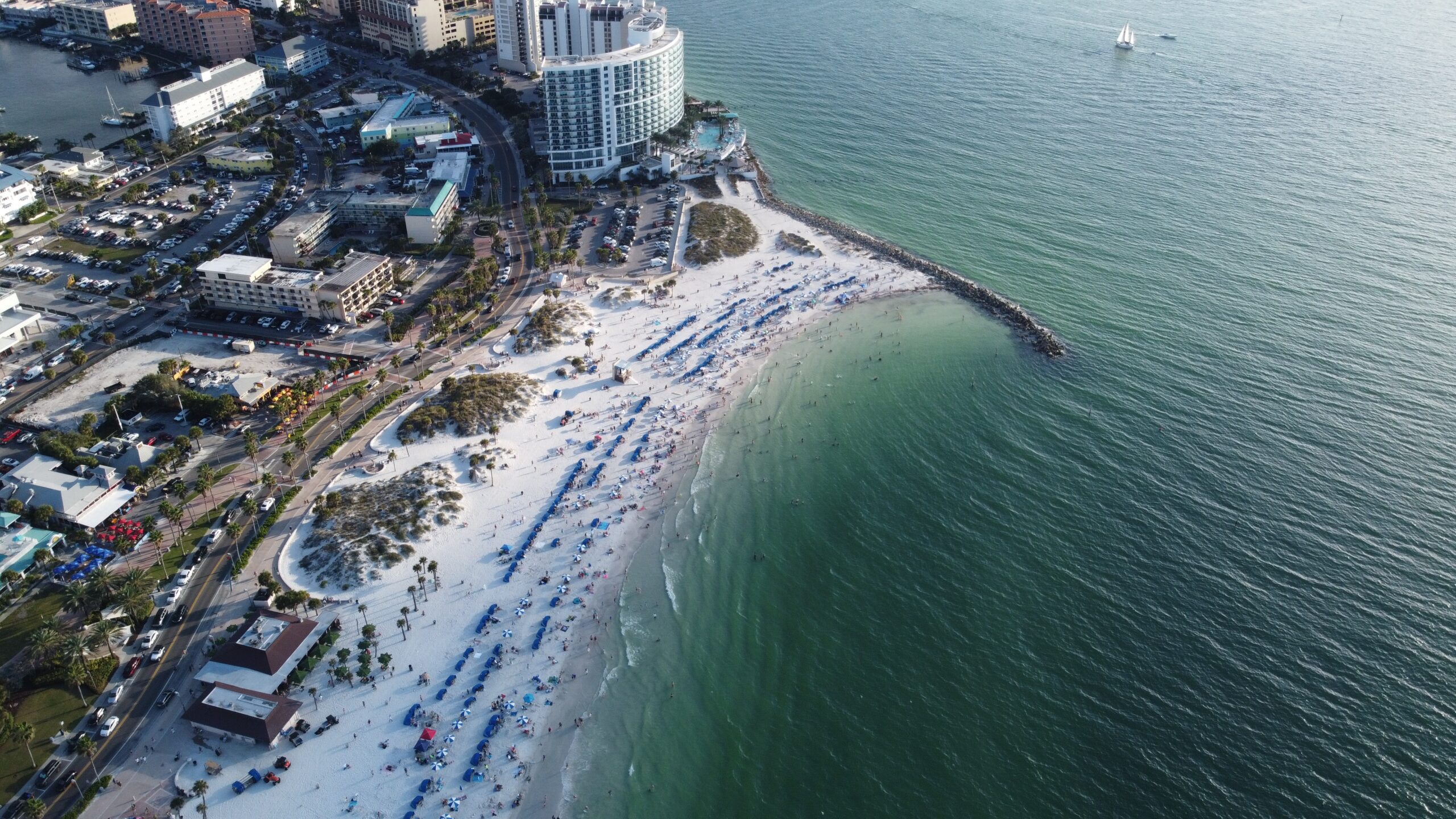
Why did Pinellas have 15 cases in 2024?
FDOH answers this one directly. Its table carries a footnote saying that in 2024, Citrus, Hernando, Hillsborough, Lee, Pasco, Pinellas and Sarasota counties saw an "unusual increase due to the impacts of Hurricane Helene." The department doesn't break down individual exposures, but its Vibrio page warns that "following a storm, such as a hurricane, flood waters and standing waters pose risks for Vibrio vulnificus exposure."
Helene came ashore in Florida's Big Bend as a Category 4 hurricane late on September 26, 2024, well north of here, but its very large wind field still drove surge down the Gulf coast. The National Hurricane Center's report on the storm says the NOAA tide gauge at Clearwater measured 6.67 feet above mean higher high water, a record for a station whose data go back to 1973. Water that high floods barrier-island streets and buildings, and cleanup means wading through floodwater and handling debris. CDC's advice to cover wounds when they might touch coastal water specifically mentions situations where "a hurricane or storm surge causes flooding."
The 2022 spike followed the same pattern farther south, where FDOH ties unusual increases in Collier and Lee counties to Hurricane Ian. The takeaway for visitors is narrow: if you're in the area after a hurricane, floodwater and storm debris are a riskier setting than a normal beach day. Our hurricane season guide for Clearwater Beach covers timing and trip planning around storms.
When is Vibrio risk highest? Season and water temperature
Summer and early fall. CDC says Vibrio bacteria "are found in higher numbers in May through October, when water temperatures are warmer," and FDOH's summary says most Florida cases are reported during those same months. That window overlaps the beach's busiest warm-weather stretch, and our guide to Clearwater Beach in summer covers storms and heat for those months. FDOH gives the bacteria's optimal growing temperature as 68 to 95°F.
To show where Clearwater Beach falls, we averaged ten years of hourly water temperature readings from NOAA's Clearwater Beach gauge (station 8726724, 2016 to 2025).
| Month | Average water temp, 2016 to 2025 | Range of monthly averages | Inside FDOH's 68 to 95°F growth range? |
|---|---|---|---|
| January | 63°F | 56 to 66°F | No |
| February | 66°F | 60 to 71°F | No, except in warm years |
| March | 72°F | 67 to 75°F | Yes |
| April | 77°F | 75 to 79°F | Yes |
| May | 82°F | 79 to 85°F | Yes (CDC/FDOH peak season starts) |
| June | 87°F | 85 to 89°F | Yes |
| July | 89°F | 88 to 90°F | Yes |
| August | 89°F | 87 to 91°F | Yes |
| September | 86°F | 84 to 87°F | Yes |
| October | 80°F | 77 to 83°F | Yes (peak season ends) |
| November | 73°F | 70 to 77°F | Yes |
| December | 67°F | 64 to 71°F | Borderline |
Read this as background, not a forecast. Water warm enough for Vibrio to grow doesn't mean infections are happening, and cooler water doesn't mean the bacteria are gone. The wound and oyster precautions apply all year. Months missing more than half their hourly readings were left out, so each month averages eight to ten years. For more on the numbers themselves, see our Clearwater Beach water temperature by month page.
Who should stay out of the water with a cut?
CDC's answer covers everyone: "If you have an open wound, stay out of saltwater or brackish water, if possible. This includes wading at the beach." Its examples of open wounds are recent cuts and scrapes, surgery sites, and new piercings or tattoos. For some people the stakes are much higher.
Who each agency names as higher risk:
- FDOH: people with weakened immune systems, "particularly those with chronic liver disease." FDOH cites a study finding that people with these pre-existing conditions were "80 times more likely" to develop Vibrio vulnificus bloodstream infections than healthy people. Its beach advice also names kidney disease.
- CDC: people with liver disease, cancer, diabetes, HIV or thalassemia; people receiving immune-suppressing therapy; people taking medicine to lower stomach acid; and people who've had recent stomach surgery.
FDOH's case data from 2008 to 2022 points the same way: 24% of Florida cases had liver disease, 29% heart disease, 22% diabetes, and 27% a history of alcohol abuse. From 2004 to 2022, two-thirds of cases were men.
FDOH tells immunocompromised people, including those with chronic liver disease or kidney disease, to "wear proper foot protection to prevent cuts and injury caused by rocks and shells on the beach." CDC similarly tells people at increased risk to wear clothes and shoes that protect against cuts and scrapes in coastal water. In practice that means water shoes on shelly stretches and near the rocks. For other things underfoot in the shallows, our stingrays and sharks page explains the stingray shuffle and stingray first aid.
CDC's prevention page says to "cover your wound with a waterproof bandage if it could come into contact with coastal waters or raw seafood, its drippings, or its juices," and to "immediately wash wounds and cuts thoroughly with soap and clean running water" after contact. CDC specifies soap as well as clean running water, so a rinse under one of the beach's outdoor rinse showers alone falls short of that advice.
Are raw oysters the bigger risk?
It depends on which Vibrio you mean. Counting all Vibrio species, FDOH and CDC both say most vibriosis comes from eating raw or undercooked shellfish, particularly oysters. For Vibrio vulnificus in Florida, the species behind 74% of the state's vibriosis deaths from 2004 to 2022, FDOH's own 2004 to 2022 data points the other way: 54% of cases were wound infections and 20% came from seafood (the rest couldn't be classified). So near the Gulf, a cut in the water deserves at least as much respect as the raw bar.
Oysters still carry enough risk that Florida makes restaurants say so. Under Florida Administrative Code rule 61C-4.010(9), any public food service establishment serving raw oysters must display this notice on menus, placards or by other effective means:
"Consumer Information: There is risk associated with consuming raw oysters. If you have chronic illness of the liver, stomach or blood or have immune disorders, you are at greater risk of serious illness from raw oysters, and should eat oysters fully cooked. If unsure of your risk, consult a physician."
FDOH's prevention list is short. Don't eat raw oysters or other raw shellfish. For shellfish in the shell, boil until the shells open and then 5 more minutes, or steam until they open and then 9 more minutes. Throw out any that don't open. Boil shucked oysters at least 3 minutes, or fry them in oil at least 10 minutes at 375°F. Keep raw seafood and its juices away from cooked food, and wear gloves if you handle raw shellfish, especially with cuts on your hands. If you're eating out, order oysters cooked; our guide to seafood restaurants on Clearwater Beach can help you pick a place.
The glove advice applies to anglers too. Cleaning a catch or handling bait with nicked fingers is exactly the raw-seafood contact both agencies warn about. Our list of restaurants that will cook your catch near Clearwater Beach also covers charters whose crews fillet the fish.
What should you do if a cut gets red or swollen after swimming?
Get it looked at right away. FDOH lists the signs of a Vibrio wound infection as fever, redness, pain, swelling, warmth, discoloration and discharge. CDC's instruction is: "Immediately see your doctor or go to the emergency room if you have symptoms of a Vibrio bloodstream or wound infection. Do not wait."
CDC also asks patients to tell their healthcare provider if they recently ate raw or undercooked seafood, or if they have an open wound that might have touched coastal water or raw seafood. FDOH gives one reason that matters: labs should use a special growth medium to find Vibrio reliably, so it helps if the clinician suspects it from the start. Mention the beach, the bay or the oyster bar when you check in.
Our Clearwater Beach emergency numbers page lists hospitals, urgent care and other local numbers. In an emergency, call 911.
A cut or scrape that turns red, warm, swollen, discolored or painful after contact with salt water or raw seafood, especially with fever or chills. FDOH calls bloodstream infection life-threatening for people with weakened immune systems, and CDC says some patients die within a day or two of becoming ill. Don't wait to see if it gets better.
How do you check beach water conditions before you swim?
Vibrio has no daily report, but other water conditions do, and each has its own page on this site:
- Bacteria sampling and swim advisories: FDOH's Healthy Beaches results for the Clearwater sites and any Pinellas advisory. Look up the latest results on FDOH's Florida Healthy Beaches page.
- Red tide: how to check current red tide levels, on our red tide at Clearwater Beach page.
- Jellyfish: seasons and first aid on our jellyfish page.
- Overall safety: crime, rip currents and beach flags are covered in Is Clearwater Beach safe?
Case and death counts come from the Florida Department of Health's Vibrio infections page as updated October 1, 2026, and from archived copies of FDOH's earlier tables. Health guidance is quoted from FDOH, FDOH's December 2023 Vibrio vulnificus summary, CDC's Vibrio pages and the Florida Administrative Code. Population figures come from the U.S. Census Bureau, water temperatures from NOAA's Clearwater Beach gauge, and storm surge data from the National Hurricane Center's Hurricane Helene report. All were checked October 4, 2026. No doctor reviewed this page, and we didn't interview patients or officials. We're an independent guide, and no business or agency named here pays us.
Frequently asked questions
Is there flesh-eating bacteria at Clearwater Beach?
Vibrio vulnificus occurs naturally in warm Gulf and brackish water all along Florida's coast, including around Clearwater Beach. Infections are rare. FDOH recorded 0 cases in Pinellas County in 2025 and 1 case in 2026 as of October 1. Infection comes through open wounds or raw shellfish, and FDOH says the serious danger is for people with weakened immune systems, particularly chronic liver disease.
Can you check Vibrio levels at Clearwater Beach today?
No. No agency we found posts a daily Vibrio level for Clearwater Beach or any other Florida beach. NOAA's experimental Tampa Bay Vibrio model covers oysters at harvest, not swimming beaches. FDOH's Healthy Beaches Program samples for enterococci, which signal sewage or stormwater pollution, so a good result there says nothing about Vibrio. Your own risk factors and any open wounds are the things to check.
How many people got Vibrio in Pinellas County?
FDOH counts for Pinellas are 15 cases and 3 deaths in 2024, 0 cases in 2025, and 1 case and 1 death in 2026 as of October 1. From 2017 to 2023 the county had between 0 and 6 cases a year. FDOH attributes the 2024 increase to Hurricane Helene.
Is it safe to swim at Clearwater Beach with a cut?
CDC's advice is to stay out of salt or brackish water with an open wound if possible, including wading. If the wound could touch the water, cover it with a waterproof bandage and wash it with soap and clean running water afterward. FDOH singles out people with chronic liver disease, kidney disease or a weakened immune system as needing extra care.
Is Vibrio worse after a hurricane?
Florida's two highest years since 2017, 2022 and 2024, both followed major hurricanes, and FDOH links each spike to storm impacts. FDOH warns that floodwater and standing water after a storm pose risks for Vibrio exposure.
Is Vibrio only a summer problem?
CDC and FDOH say infections are most common May through October, when the water is warmest. At Clearwater Beach, the average Gulf temperature is about 72°F or warmer from March through November. The precautions apply year-round.
Are raw oysters safe in Clearwater?
FDOH advises against eating raw oysters or other raw shellfish, and Florida requires restaurants serving them to warn that people with chronic liver, stomach or blood illness or immune disorders should eat oysters fully cooked. Raw shellfish cause most vibriosis overall, though in Florida's Vibrio vulnificus cases, wound infections are more common than seafood ones.
Sources
- Florida Department of Health, Vibrio Vulnificus (Vibrio infections), statewide cases by year 2017 to 2026 and county table 2024 to 2026, "Updated 10:30 a.m. ET, October 1" (page modified October 1, 2026), accessed October 4, 2026. floridahealth.gov
- Florida Department of Health, Vibrio vulnificus summary (updated December 2023): growth temperatures, 2000 to 2022 averages, seasonality, exposure and risk-factor shares, raw oyster notice. floridahealth.gov (PDF)
- Florida Department of Health, former Vibrio vulnificus page (floridahealth.gov/diseases-and-conditions/vibrio-infections/vibrio-vulnificus/), county tables as captured by the Internet Archive on February 12, 2019; February 10, 2020; February 25, 2021; March 7, 2022; February 9, 2023; March 3, 2024; February 28, 2025; and November 1, 2025.
- Florida Administrative Code Rule 61C-4.010(9), consumer advisory for raw oysters (rule last amended October 18, 2023). flrules.org
- NOAA National Centers for Coastal Ocean Science, Vibrio predictive models (experimental; shellfish guidance for Tampa Bay, water guidance for Chesapeake Bay only). coastalscience.noaa.gov
- Florida Department of Health, Florida Healthy Beaches Program (enterococci sampling and categories). floridahealth.gov
- Centers for Disease Control and Prevention, About Vibrio Infection (higher-risk groups, seasonality, necrotizing fasciitis, when to seek care). cdc.gov
- Centers for Disease Control and Prevention, Preventing Vibrio Infection (wounds, bandages, washing, flooding). cdc.gov
- U.S. Census Bureau, county population totals, Vintage 2025 (2020 to 2025) and Vintage 2020 (2010 to 2020). census.gov
- NOAA National Hurricane Center, Tropical Cyclone Report: Hurricane Helene (AL092024). nhc.noaa.gov (PDF)
- NOAA Tides and Currents, Clearwater Beach, FL station 8726724, hourly water temperature, January 2016 to December 2025, retrieved October 2026. tidesandcurrents.noaa.gov
Planning a beach day at Clearwater?
Check the flag, the water and the weather before you go, and pack water shoes if you have a cut to protect.
Plan your visit