
Often, but not every day. When the wind is light, the Gulf at Clearwater Beach is clear and green. Strong west winds, cold fronts, storms and heavy rain turn it cloudy for a day or more. The Florida Department of Health tests for bacteria about every two weeks at Pier 60, Mandalay Park and Sand Key, and the September 28, 2026 samples at Pier 60 and Mandalay Park both came back good. Surf is usually 2 feet or less.
Key takeaways
- Clarity changes day to day. Wind, waves, rain runoff and storms matter far more than the month.
- The name doesn't come from the Gulf. The City of Clearwater says it refers to clear springs that once flowed from the downtown bluffs into the bay.
- Florida Health samples three nearby sites for enterococci bacteria: Clearwater Beach - Pier 60, Clearwater Beach - Mandalay Park and Sand Key. A result over 70 per 100 mL that's confirmed by a resample triggers an advisory.
- Advisories here have been short. The May 15, 2025 advisory for Mandalay Park, Sand Key and Indian Rocks was lifted the next day.
- The warning flags on the lifeguard towers cover surf, currents and dangerous marine life, not water quality. Red tide (FWC) and bacteria (Florida Health) are separate checks.
- Surfers and paddleboarders must stay outside the swim zone or go to North Beach past Somerset Street, per city rules.
Is the water at Clearwater Beach actually clear?
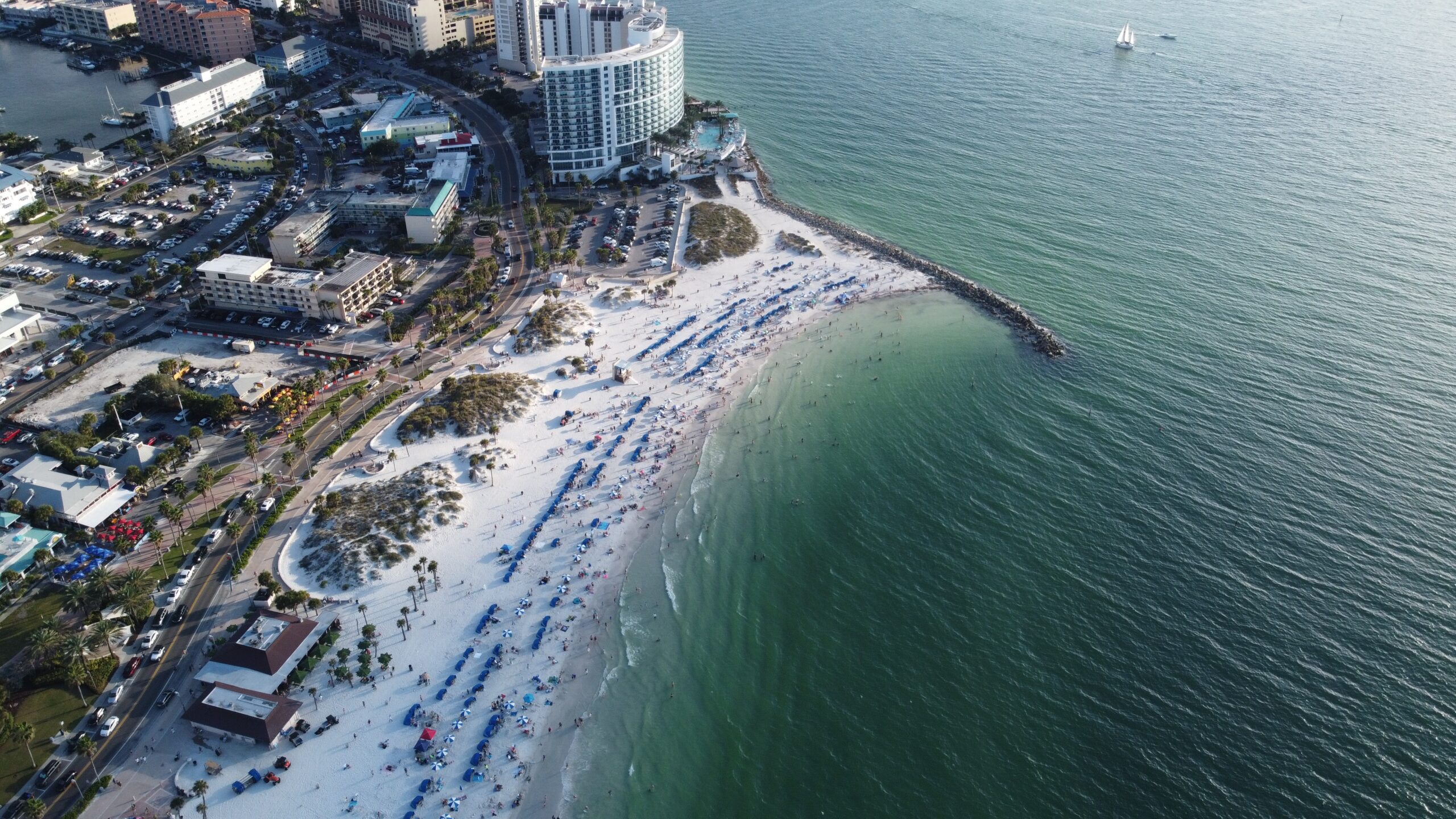
On a calm day, yes. The shallows are usually a clear green over white sand, and from above you can pick out the lighter sandbars and the darker water where the bottom drops off. Don't expect Caribbean blue or the Florida Keys. Think green, not turquoise.
On a rough day, no. Waves churn fine sand and shell off the bottom and the water near shore goes milky or tan. Heavy rain adds runoff. A passing storm can leave the Gulf cloudy for a day or two after the wind dies.
As for the name, it was never a promise about the Gulf. The City of Clearwater says clear springs "gurgled from the banks into the bay" along the high bluffs where downtown sits now. Early settlers called the place Clear Water Harbor until 1895, when Clearwater became one word. The beach itself is on a barrier island across the harbor, and our guide to the city of Clearwater versus the beach explains how the two differ.
Why is the water clear some days and murky others?
Four things do almost all the work. None of them can be forecast weeks ahead.
- Wind direction and strength. Clearwater Beach faces west. Light winds, or winds blowing from the land out to sea (east), flatten the water near shore and let sediment settle. Steady west or northwest winds push waves onto the beach and keep the bottom stirred up.
- Waves and storms. The bigger the surf, the more sand and shell fragments stay suspended. Winter cold fronts and tropical systems are the usual culprits. Clarity often lags the weather by a day or so after the wind drops.
- Rain and runoff. Heavy rain washes stormwater, sediment and darker, tea-colored water from the bays and inlets into the Gulf. The EPA names polluted runoff ("water that drains after rainfall") as one way swimmers get exposed to harmful germs, so runoff affects how clean the water is, not just how it looks (see bacteria testing below).
- What's growing in the water. Algae blooms, including red tide, can tint the water brown or rusty. Washed-up seaweed and seagrass are a different thing and perfectly normal. They float in after wind and waves and pile up at the tide line.
Go in the morning after two or three calm days in a row, and skip the day after a front or a big storm. Before you leave, pull up a live camera (our Clearwater Beach webcams guide lists them) and look at the water color yourself.
When is the water clearest? Clarity by season
Nobody publishes a clarity measurement for Clearwater Beach. The table is a general pattern built from the weather that drives clarity, not a forecast. Every month has calm, clear days, and every month has murky ones.
| Months | What drives the water | What to expect |
|---|---|---|
| December to February | Cold fronts pass through, followed by strong north or northwest winds | Rough, cloudy water for a day or two after each front, clear and calm in between. The water is also at its coldest; see our water temperature by month guide. |
| March to mid-May | Fronts become less frequent; the summer rainy season hasn't started | Often a good stretch for calm, clear days, with less rain runoff than summer |
| Late May to early October | The National Weather Service's rainy season for West Central Florida runs about May 25 to October 10. Hurricane season runs June 1 to November 30. | Mornings are often flat and clear. Afternoon storms bring runoff, and heavy rain is when bacteria counts tend to rise. Tropical systems can cloud the water for days. |
| Mid-October to November | Rainy season ends; fronts start returning later in the fall | Drier weather and less runoff; clarity depends on wind and any late-season storms |
Is the water clean? Bacteria testing and swim advisories
Clear and clean aren't the same thing. Water can look perfect after heavy rain and still carry bacteria, while slightly cloudy water after a windy day is usually just stirred-up sand. Only the test results tell you which is which.
The Florida Department of Health's Healthy Beaches Program samples marine beaches for enterococci, bacteria that live in human and animal intestines and can indicate fecal pollution. The state says it samples every two weeks, a schedule in place since funding changes in 2011. Pinellas County results follow that pattern, with a resample a couple of days later when a result comes back high (as of October 2026). The three sampling sites closest to the beach are Clearwater Beach - Pier 60, Clearwater Beach - Mandalay Park (north of Pier 60) and Sand Key.
| Florida Health rating | Enterococci per 100 mL of seawater |
|---|---|
| Good | 0 to 35 |
| Moderate | 36 to 70 |
| Poor | 71 or greater |
| Advisory issued | A result over 70, and a resample that also exceeds 70 |
The resample rule matters, because one high reading doesn't automatically mean an advisory. In summer 2026, Florida Health's sampling data showed Pier 60 at 240 on July 20 and 160 on August 3, and Mandalay Park at 110 on August 3. Each site was resampled two days later, came back in the good range, and no advisory went up for Clearwater Beach. Nearby, the department did post advisories on August 6 for Honeymoon Island (Dunedin) Causeway-South and Courtney Campbell Causeway, and lifted them the next day. The most recent samples at both Clearwater Beach sites, taken September 28, 2026, were in the good range.
Examples of past advisories at Clearwater Beach
| Issued | Beaches named | Lifted | Context |
|---|---|---|---|
| May 15, 2025 | Clearwater Beach near Mandalay Park, Sand Key County Beach, Indian Rocks County Beach | May 16, 2025 | Enterococci above the action threshold; the department said testing from May 15 showed acceptable levels |
| September 1, 2023 | Clearwater Beach Mandalay Park, Sand Key | September 5, 2023 | After Hurricane Idalia; the department noted storm surge can carry contaminants from land into the Gulf |
Both were lifted within one to four days. Short or not, stay out of the water while an advisory is active. The EPA's general advice is to skip urban beaches after heavy rainfall and to avoid swallowing water.
Florida Health warns that Vibrio vulnificus occurs naturally in warm seawater and can infect open wounds through direct contact. Our guide explains how rare Vibrio infections really are and who faces the most risk. If you have a fresh cut, scrape or surgical wound, keep it out of the Gulf. The department's swim advisories also say to wash any cut with soap and water, apply antibiotic cream, and see a doctor if it turns red, swells or starts draining.
What about red tide and seaweed?
Red tide is a bloom of the algae Karenia brevis. When it reaches the beach it can discolor the water, kill fish and cause coughing and sneezing on the sand. Blooms come and go. The Florida Fish and Wildlife Conservation Commission (FWC) publishes a statewide status report on Fridays, with extra updates on Wednesdays when available, and a daily sampling map. Its October 2, 2026 report listed detections only in Gulf County and Sarasota County, none in Pinellas.
FWC's concentration scale runs from background (1,000 cells per liter or less) up to high (more than 1 million cells per liter). Our red tide at Clearwater Beach guide explains what each level means for beachgoers and how to read the map.
Seaweed is a smaller deal. A dark line of washed-up seaweed and seagrass along the high-tide mark is normal, especially after wind. If you see large floating mats of brown sargassum, Florida Health has a sargassum fact sheet on handling it safely.
Does Clearwater Beach have waves? Can you surf?
Small ones, most of the time. On calm days the surf is a foot or less, which is ideal for kids and wading. On October 4, 2026, for example, the National Weather Service Tampa Bay surf zone forecast called for surf of 1 to 2 feet at Clearwater Beach, dropping to 1 foot or less the next day.
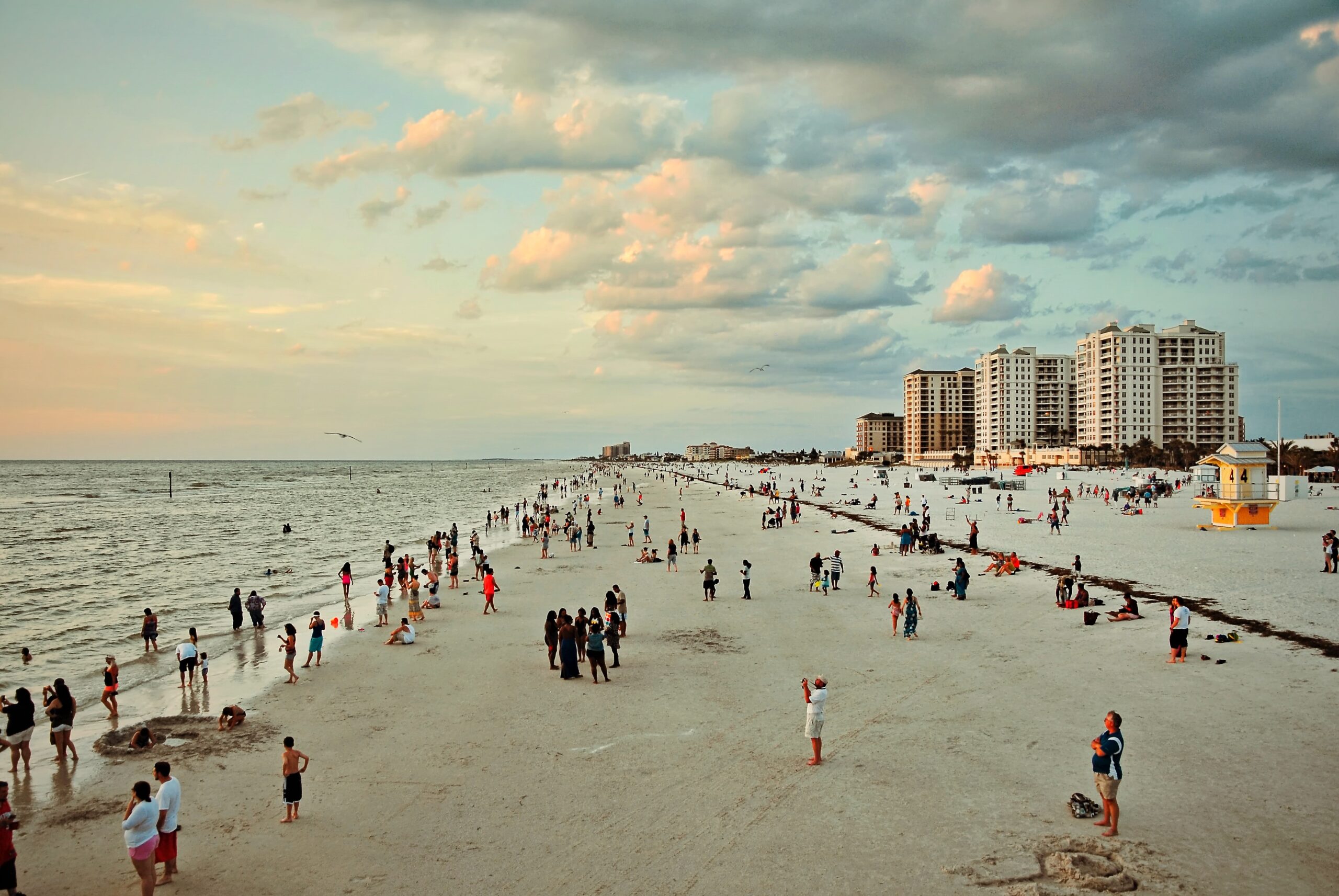
Rideable surf shows up when strong onshore winds blow for a while, mostly with winter cold fronts and with tropical systems passing offshore. Those are also the days the water is at its cloudiest and rip currents are most likely, so check the beach warning flag before anyone goes in. Small surf doesn't mean zero risk, either.
Where boards are allowed. The City of Clearwater's beach rules say surfboards, sailboats, motorboats, personal watercraft and "singular hard-surfaced objects" can't be beached on the public bathing beach. Surfing, paddleboarding, windsurfing and skimboarding "must be done outside the swim zone or on North Beach past Somerset Street." Our Clearwater Beach rules guide covers the city code behind this and where the protected swim zone runs. The city says lifeguards are on duty 10 a.m. to 5 p.m., seven days a week. The same windy days that cloud the water tend to suit kiteboarding and sailing.
Where is the clearest water near Clearwater Beach, and in Florida?
Nearby: no single beach is reliably clearer every day, because the same wind, rain and storms hit this whole stretch of coast. The open Gulf side of a barrier island generally looks clearer than spots near the passes or on the bay side, where darker bay water moves in and out with the tide. Your best bet is the open Gulf on a calm morning. A boat trip to a less developed island such as Caladesi Island, or out to deeper water near the artificial reefs offshore, gets you away from the busiest stretches of shoreline. For seeing anything underwater, our snorkeling guide covers the spots and the conditions that matter.
In Florida: if crystal-clear water is the whole point of the trip, two parts of the state are better known for it than the Tampa Bay coast.
- The Florida Keys. NOAA's Florida Keys National Marine Sanctuary protects North America's only coral barrier reef, and NOAA itself describes the water's "sparkling turquoise color." This is where to go for reef snorkeling and diving.
- The Panhandle. Walton County's official tourism office promotes its beaches for "sugar-white sand and turquoise water." Our Clearwater Beach vs Destin comparison weighs the water against the drive and everything else.
Verdict: for a busy, easy-to-reach city beach, Clearwater Beach's water is very good, and on calm days it's genuinely pretty. It isn't the clearest water in Florida, and on windy days it isn't close.
How do I check today's water conditions?
Five free sources cover clarity, cleanliness and safety. Check the first two every time, and the rest when the weather has been rough or rainy.
| What you want to know | Where to check | What it tells you |
|---|---|---|
| Surf, rip currents, water temperature | NWS Tampa Bay surf zone forecast | Rip current risk, surf height in feet, UV index, water temperature, wind and tides for the Pinellas beaches, including Clearwater Beach |
| Bacteria | Florida Health beach lookup map | Latest enterococci results and advisories for Pier 60, Mandalay Park and Sand Key |
| Red tide | FWC red tide status | Weekly status report and daily sampling map by county |
| Water color, dead fish, irritation | Mote Marine's Beach Conditions Reporting System | Reports from trained volunteers on water color, respiratory irritation and dead fish; Clearwater Beach is one of the listed beaches |
| Wind and water temperature right now | NOAA station CWBF1 at Clearwater Beach | Live wind speed and direction, water temperature and water level; a west wind usually means choppier, cloudier water |
Skip the wave buoys. The nearest one listed by NOAA's National Data Buoy Center, station 42099 "Offshore St. Petersburg," sits roughly 100 miles from Clearwater Beach (our estimate from its published coordinates). Conditions that far out often don't match what reaches the sand, so use the NWS surf forecast for beach surf height.
Compiled from the Florida Department of Health, FWC, the National Weather Service, NOAA, the EPA, the City of Clearwater and Mote Marine Laboratory sources listed below. Sampling results, forecasts and the red tide status were checked in October 2026. The latest bacteria results come from Florida Health's results page; the summer 2026 history comes from Florida Health sampling data as compiled by an independent results site, so confirm on the Florida Health map. We did not measure water clarity, and no one publishes a clarity reading for this beach, so the seasonal pattern above is a general guide. We are an independent guide and are not paid by any business or agency named here.
Frequently asked questions
Why is it called Clearwater if the water isn't always clear?
The name has nothing to do with the Gulf. The City of Clearwater says it refers to clear springs that flowed from the bluffs (where downtown is now) into the bay. It was known as Clear Water Harbor until 1895. The beach is on a barrier island across the harbor.
Is it safe to swim at Clearwater Beach?
Usually, yes. Florida Health's bacteria results for the Pier 60 and Mandalay Park sites are mostly in the good range, and the past advisories listed above were lifted within one to four days. Lifeguards are on duty 10 a.m. to 5 p.m. daily. Check the flag for rip currents, the Florida Health map for bacteria after heavy rain, and FWC for red tide.
Should I swim after heavy rain?
Better to wait. Rain washes stormwater runoff into the Gulf, and that's when bacteria counts tend to spike. The EPA advises avoiding urban beaches after heavy rainfall. Give it a day or two and check the latest Florida Health result before you go in.
Does the warning flag tell me if the water is clean?
No. The flags on the lifeguard towers are about surf, currents and dangerous marine life. Bacteria advisories come from Florida Health and red tide reports from FWC, and neither changes the flag color.
Can you surf at Clearwater Beach?
Sometimes, on windy days when a front or tropical system pushes waves in. Most days the surf is 1 to 2 feet or smaller. Boards have to stay outside the swim zone or on North Beach past Somerset Street under city rules.
Can you see fish and stingrays in the water?
On calm, clear days, often yes: small fish and rays show up in the shallows. Shuffle your feet as you wade so you don't step on a stingray. Our guide to stingrays in the shallows covers the shuffle and what to do if you get stung.
Sources
- Florida Department of Health, Beach Water Quality (enterococci categories, advisory rule, bi-weekly sampling). floridahealth.gov
- Florida Department of Health, Florida Healthy Beaches Lookup map (sampling every 1 to 2 weeks depending on county; Pinellas sampling sites). fdoh.maps.arcgis.com
- Florida Department of Health, Pinellas County beach sampling results (latest samples September 28, 2026) for Clearwater Beach - Pier 60 and Clearwater Beach - Mandalay Park. Summer 2026 readings were taken from Florida Health data as republished by floridahealthybeaches.com, an independent site. Pier 60 results, Mandalay Park results
- Florida Department of Health in Pinellas County, "Precautionary Swim Advisory," May 15, 2025. pinellas.floridahealth.gov
- Florida Department of Health in Pinellas County, "Pinellas Lifts Water Quality Advisory," May 16, 2025. pinellas.floridahealth.gov
- Florida Department of Health in Pinellas County, precautionary swim advisory issued September 1, 2023 and rescinded September 5, 2023. Issued, rescinded
- Florida Department of Health in Pinellas County, water quality health advisories issued August 6, 2026 and lifted August 7, 2026. Issued, lifted
- Florida Department of Health, Vibrio vulnificus. floridahealth.gov
- U.S. Environmental Protection Agency, What Affects Human Health at the Beach. epa.gov
- Florida Fish and Wildlife Conservation Commission, Red Tide Current Status (report of October 2, 2026; concentration categories). myfwc.com
- City of Clearwater, Clearwater Beach Rules & Information (surfing and watercraft, lifeguard hours, flags). myclearwater.com
- City of Clearwater, About Clearwater (history of the name). myclearwater.com
- National Weather Service Tampa Bay, Surf Zone Forecast, issued 3:38 a.m. EDT October 4, 2026. weather.gov
- National Weather Service Tampa Bay, Rainy Season. weather.gov
- NOAA National Data Buoy Center, stations CWBF1 (Clearwater Beach) and 42099 (Offshore St. Petersburg). CWBF1, 42099
- Mote Marine Laboratory & Aquarium, Beach Conditions Reporting System. mote.org
- NOAA Florida Keys National Marine Sanctuary, Welcome. floridakeys.noaa.gov
- Walton County Tourist Development Council, Beaches. visitsouthwalton.com
Planning a beach day?
Check the flag, the water temperature and the webcams, then pick your spot on the sand.
Check today's beach flag