
Brown pelicans, ospreys and bottlenose dolphins show up in every month, and black skimmers and American oystercatchers work the sand most of the year. Ghost crabs are a May-to-October animal. Alligators don't live on Clearwater Beach: none of 382 precisely mapped iNaturalist gator records within 12 km of Pier 60 fell on the barrier islands. Stay out of roped, posted nesting areas, especially during Pinellas County's February 15 to September 1 shorebird season.
Key takeaways
- Brown pelicans (555 records) and ospreys (492) top the 12 animal groups in our calendar, built from 10 years (2016 to 2025) of verified sightings within 12 km of Pier 60.
- 63% of osprey records fall between December and April. Every least tern record falls between March and July.
- FWC's shorebird breeding season for Pinellas County runs February 15 to September 1. Stay out of roped, posted areas.
- Feeding an alligator breaks rule 68A-25.001, and a first offense carries a $100 civil penalty. Gator concerns: 866-FWC-GATOR (866-392-4286).
- Taking any live shell, sand dollar or sea star requires a Florida saltwater fishing license, and sea stars count toward a bag limit.
What animals will you see at Clearwater Beach?
Mostly birds. Brown pelicans work the surf and perch on pier railings, ospreys hunt over the shallows, and terns, gulls and skimmers rest on the open sand. Bottlenose dolphins turn up in every month of our data.
Look down and you'll find ghost crabs in the warm months, sand dollars, the odd sea star and stingrays. Stingrays are the one animal to plan around: shuffle your feet when you wade. Ranked by verified records, the five you're most likely to see are the brown pelican, osprey, American oystercatcher, bottlenose dolphin and black skimmer.
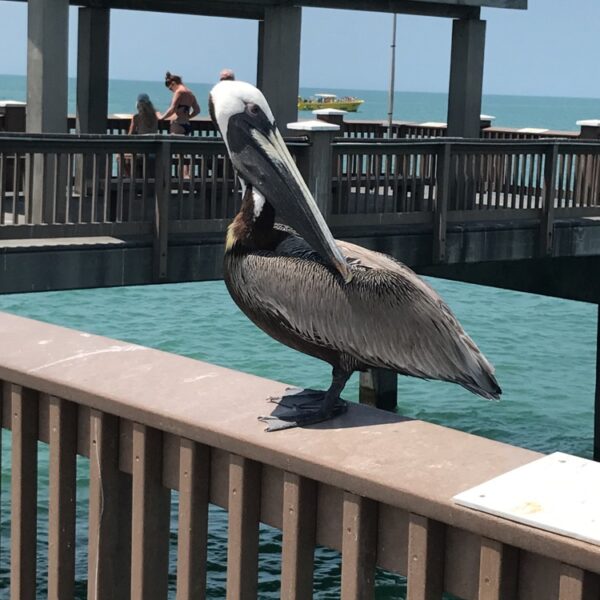
NOAA Fisheries says feeding or harassing wild dolphins is illegal under the Marine Mammal Protection Act, with fines of up to $100,000 and up to a year in jail. It asks people to watch from at least 50 yards (150 feet).
What can you see at Clearwater Beach each month?
Each cell counts verified iNaturalist sightings of that animal in that month, added up over 2016 to 2025, within 12 km (7.5 miles) of Pier 60. That circle takes in Clearwater Beach, Sand Key, Caladesi, most of Honeymoon Island and Clearwater Harbor, plus the mainland from Dunedin down to Largo, so the bird rows include some inland sightings. Bold marks a busy month: at least five records and at least 1.5 times the animal's usual share, after adjusting for how many people were posting that month. Two rows are official seasons, not counts. Names link to our page on that animal or to the section below.
| Animal | Jan | Feb | Mar | Apr | May | Jun | Jul | Aug | Sep | Oct | Nov | Dec | 10-yr total |
|---|---|---|---|---|---|---|---|---|---|---|---|---|---|
| Bottlenose dolphin | 9 | 15 | 17 | 23 | 20 | 9 | 12 | 17 | 8 | 14 | 11 | 20 | 175 |
| Manatee | 1 | 0 | 5 | 4 | 10 | 1 | 4 | 3 | 1 | 0 | 0 | 3 | 32 |
| Stingrays | 0 | 2 | 0 | 0 | 2 | 2 | 1 | 5 | 1 | 4 | 2 | 2 | 21 |
| Sea turtle nesting season | Season | Season | Season | Season | Season | Season | May 1 to Oct 31 | ||||||
| Shorebird nesting season | From 15th | Season | Season | Season | Season | Season | Season | To Sep 1 | Feb 15 to Sep 1 | ||||
| Black skimmer | 13 | 4 | 6 | 9 | 12 | 7 | 19 | 12 | 2 | 3 | 5 | 10 | 102 |
| Least tern | 0 | 0 | 1 | 2 | 5 | 2 | 2 | 0 | 0 | 0 | 0 | 0 | 12 |
| Snowy plover | 3 | 1 | 0 | 0 | 1 | 1 | 0 | 0 | 0 | 2 | 0 | 1 | 9 |
| American oystercatcher | 28 | 30 | 20 | 6 | 13 | 6 | 9 | 10 | 9 | 10 | 18 | 18 | 177 |
| Brown pelican | 39 | 56 | 70 | 56 | 39 | 45 | 36 | 40 | 38 | 30 | 34 | 72 | 555 |
| Osprey | 71 | 44 | 61 | 74 | 51 | 22 | 18 | 15 | 23 | 25 | 27 | 61 | 492 |
| Ghost crab | 0 | 0 | 3 | 1 | 9 | 10 | 7 | 10 | 7 | 12 | 2 | 2 | 63 |
| Sand dollars | 0 | 2 | 4 | 5 | 1 | 1 | 9 | 3 | 4 | 0 | 0 | 1 | 30 |
| Sea stars | 3 | 5 | 6 | 2 | 3 | 4 | 5 | 1 | 5 | 4 | 2 | 7 | 47 |
Season rows: turtle nesting dates are from Clearwater Marine Aquarium, which patrols about 21 miles of north Pinellas beaches. Shorebird dates are FWC's Southwest Region breeding season, which covers Pinellas County.
What the calendar shows
- Pelicans and dolphins never take a month off. Pelicans ranged from 30 records (October) to 72 (December), dolphins from 8 (September) to 23 (April).
- Ospreys fade in summer. 311 of 492 records fall December to April.
- Oystercatchers peak in winter. November to February holds 94 of 177 records, which fits FWC's note that migrants join the residents outside nesting season.
- Least terns are warm-season visitors. All 12 records fall March to July. FWC says they're in Florida only to breed and spend the rest of the year in Central and South America.
- Ghost crabs go quiet in winter. Zero records in January or February; 55 of 63 fall May to October.
- Small rows are small. Snowy plover (9), least tern (12) and stingrays (21) tell you the animal is around, not when to expect it.
Data: the iNaturalist public API (v1, monthly histograms). Research-grade records only (dated, located photos with a community-confirmed ID), wild animals only, observed January 1, 2016 through December 31, 2025, within 12 km of Pier 60 (27.9775° N, 82.8278° W). Retrieved October 4 and 5, 2026. The circle includes mainland neighborhoods as well as the beach. Stingrays combine four species (Atlantic, bluntnose, southern, yellow); sand dollars are the keyhole genus Mellita; sea stars are the class Asteroidea.
Adjustment and checks: all-species records in the same circle ranged from 2,638 (November) to 5,710 (March), so we divided each animal's share of each month's records by its share of the whole year's. We also pulled every record to count observers: the biggest single-observer share was 8 of 21 stingray records (38%), and the monthly totals matched exactly. Sea turtles had only 9 records, so that row uses the official nesting season. These are sightings people chose to post, not surveys. They show when an animal tends to be seen, not how many exist. Our scripts and results are archived so the numbers can be re-run.
When are shorebird nesting areas closed, and what are the rules?
Four beach-nesting birds found around Clearwater are state-Threatened: the American oystercatcher, snowy plover, black skimmer and least tern. They lay eggs in shallow scrapes on open sand or shell, and the eggs and chicks are camouflaged well enough to step on without noticing. FWC's breeding season for its Southwest Region, which includes Pinellas County, runs February 15 to September 1.
Rule 68A-27.003, Florida Administrative Code, prohibits "take" of these birds, which includes harm and harassment. FWC's Imperiled Beach-Nesting Bird guidelines, in effect since October 1, 2024, give examples of harassment: walking into a colony and flushing the birds, a dog owner who lets a dog flush them, fireworks, and drones. Intentionally killing a Threatened species or destroying its eggs or nest is a third-degree felony (sections 379.411 and 379.401, Florida Statutes). The city's own code adds limits too; see the city's rules on dogs and drones on the beach.
Per the guidelines, walking the beach outside posted areas isn't expected to cause take, and neither is watching or photographing from outside the posting, or from more than 300 feet from an unposted active nest. If birds start calling, dive-bombing or flushing, you're too close: back off. FWC also asks you to keep dogs leashed and away from nesting areas and not to fly kites near them. Postings move as the birds do; one fixed example is the stretch of Three Rooker Island that closes each spring and summer (see our Three Rooker Island guide).
- Posts and rope with FWC signs around open sand: a shorebird or seabird posted area (FWC "Regulatory Boundary Signs"). FWC's guidelines say entering one is likely to cause take. Stay out in any month.
- Stakes and tape around a patch of sand near the dunes: a sea turtle nest. Clearwater Marine Aquarium's morning patrols mark nests during the season. Leave it alone, and keep lights off the beach at night; CMA asks for turtle-friendly lighting.
- "Don't Feed Wild Dolphins": NOAA's sign for piers, docks, ramps and marinas. Feeding them is illegal under federal law.
- "Do Not Feed Alligators": FWC's sign for ponds and canals, with the 866-FWC-GATOR hotline on it. You won't see it on the Gulf beach.
Where are the best birding spots near Clearwater Beach?
Three Great Florida Birding and Wildlife Trail sites (an FWC program) sit on the islands next to Clearwater Beach. A fourth is inland, and it's the one to pick if you also want an alligator.
- Honeymoon Island State Park (#1 Causeway Blvd., Dunedin; 8 a.m. to sunset; $8 per vehicle as of October 2026; about 13 road miles from Pier 60). The Birding Trail calls the Osprey Trail probably the best place in the world to watch ospreys nest. Florida State Parks lists oystercatchers, snowy plovers and least terns among the island's nesting birds, so expect closed nesting areas on the beach in season. Details are in our Honeymoon Island guide.
- Caladesi Island State Park, reached by ferry from Honeymoon or by private boat. The Birding Trail lists it as an Important Bird Area, with red knots and piping plovers in winter and nesting oystercatchers and black skimmers.
- Sand Key Park (1060 Gulf Blvd., Clearwater; 7 a.m. to sunset; about 2.4 road miles from Pier 60). The Birding Trail points to sanderlings, oystercatchers and skimmers on the beach, common loons and northern gannets offshore in winter, and dolphins and pelicans in Clearwater Pass at the park's north edge. To pick among Honeymoon, Caladesi and Sand Key, compare these beaches on drive time and fees.
- Sawgrass Lake Park (7400 25th St. N., St. Petersburg; 7 a.m. to sunset; free). More than 200 bird species have been recorded here, per the Birding Trail, and it's one of the gator parks below.
Are there alligators at Clearwater Beach?
No. FWC says alligators prefer freshwater lakes, slow-moving rivers and their wetlands, though they can turn up in brackish water. A Gulf beach is neither. iNaturalist holds 456 verified alligator records within 12 km of Pier 60 from 2016 to 2025. Of the 382 with precise public locations, none fell on Clearwater Beach, Sand Key, Caladesi or Honeymoon Island. The most common place names on the records are Largo and Walsingham Park. A stray on a barrier island isn't impossible, just very unlikely.
FWC says alligators live in all 67 Florida counties, so if you want to see one, head inland to fresh water. Of the parks we checked, these three had the most records:
| Park | From Pier 60 | Gator records within 1.5 km, 2016 to 2025 | Hours and entry (as of Oct 2026) |
|---|---|---|---|
| Walsingham Park, 12615 102nd Avenue, Seminole (a Pinellas County park in Largo built around a 100-acre lake) | About 10 road miles, about 25 min | 165 | Daily 7 a.m. to sunset; swimming in the lake is prohibited |
| Sawgrass Lake Park, 7400 25th St. N., St. Petersburg | About 18 road miles, about 35 min | 283 | Daily 7 a.m. to sunset; free. The Birding Trail points to the two-story observation deck on Sawgrass Lake for alligators. |
| Boyd Hill Nature Preserve, 1101 Country Club Way S., St. Petersburg | About 26 road miles, about 45 to 50 min | 334 | Closed Mondays. Tuesday to Sunday 9 a.m. to 7 p.m. through Oct 31, then 9 a.m. to 6 p.m. from Nov 1 (Saturdays open at 7 a.m.). $3 adults, $1.50 ages 3 to 16. Nature center exhibits are closed for renovation; the trails are open. |
Drive times are no-traffic routing estimates, and gator counts are iNaturalist records within 1.5 km of each park. Pinellas County parks close the day after Thanksgiving and on December 25; Boyd Hill also closes Thanksgiving, Christmas and New Year's Day. Check before you go.
FWC's advice: keep your distance, swim only in designated areas in daylight, keep pets leashed and away from the water, and never feed a gator. Rule 68A-25.001, Florida Administrative Code, bars intentionally feeding or enticing one. Under section 379.412, Florida Statutes, a first violation is a $100 civil penalty, a second a second-degree misdemeanor and a third a first-degree misdemeanor. A fourth violation is a third-degree felony. Worried about an alligator? Call 866-FWC-GATOR (866-392-4286). To report someone feeding one, call FWC Wildlife Alert at 888-404-3922.
Does Clearwater Beach have crabs?
Yes. The one you'll notice is the Atlantic ghost crab, which lives in burrows in the dry sand. In our data it's a warm-weather animal: 63 records, none in January or February, and the most in October (12). Hermit crabs are common too, with 79 verified records in the same circle and years. They're on Florida's marine life species list (rule 68B-42.001(3)(u)), so taking one falls under the bag limits below.
Can you take sand dollars, sea stars or live shells from Clearwater Beach?
Empty shells, yes. Anything still alive falls under Florida's rules, which vary by animal. Before you pocket a sand dollar, sea star or shell, check whether something is living in or on it.
| What you find | The rule | Source |
|---|---|---|
| Any shell with a living animal inside, including live sand dollars | A Florida recreational saltwater fishing license is required to harvest it, even from shore | FWC, Recreational Sea Shell Collecting |
| Live sea stars (starfish) | Designated "marine life" species. Limit of 20 marine life organisms per person per day, no more than 5 of any one species; no more than 40 in possession | Rules 68B-42.001(3)(m) and 68B-42.005(2), F.A.C. |
| Bahama starfish (cushion star) | Harvest and possession prohibited | Rule 68B-42.003, F.A.C. |
| Live sand dollars | Not a marine life species: the rule's sea urchin category excludes sand dollars and sea biscuits. The license requirement still applies | Rule 68B-42.001(3)(o), F.A.C. |
| Live shellfish in Lee County (Sanibel, Fort Myers Beach) | No harvest at all. "Live shellfish" includes mollusks and echinoderms such as sand dollars and sea stars, with exceptions for oysters, hard clams, sunray venus clams, bay scallops and coquinas | Rules 68B-26.004(1) and 68B-26.002, F.A.C. |
| Live shellfish in Manatee County (Anna Maria Island) | No more than 2 of any single species per day | Rule 68B-26.004(2), F.A.C. |
| Live shells at Caladesi Island State Park | Live shelling is prohibited | Florida State Parks, Caladesi experiences page |
Pinellas County isn't one of the two counties named in rule 68B-26.004, so the statewide rules apply on Clearwater Beach. Parks can set stricter limits, as Caladesi does. Bay scallops are a separate fishery with their own zones and dates; see our guide to bay scallop season near Clearwater. The simplest way to stay legal: if it's alive, put it back in the water. For the license, see our Florida saltwater fishing license guide. For finding empty shells, see our shelling guide.
What should you do about an injured bird or stranded animal?
- Hooked or tangled bird: FWC says don't cut the line. Reel the bird in slowly, lift it onto a pier with a net, cover its head, cut the barb and back the hook out, and remove all line. If it swallowed the hook or is badly hurt, stay with it and call a rehabilitator. The same steps apply on any of the area fishing piers.
- Any injured wild bird: Seaside Seabird Sanctuary, 18328 Gulf Blvd., Indian Shores (about 10.6 road miles south of Pier 60). Rescue hotline 727-391-6211, extension 1; 24-hour drop-off. Hurricane Helene pushed about 4 feet of seawater onto its campus in September 2024; the sanctuary says it didn't lose any birds. It's open daily, but its site lists both 8 a.m. to 4 p.m. and 9 a.m. to 5 p.m. as of October 2026, so call before visiting.
- Stranded dolphin, sea turtle or other marine animal: Clearwater Marine Aquarium's 24-hour hotline, 727-441-1790, extension 1.
- Injured manatee, or someone harassing wildlife: FWC Wildlife Alert, 888-404-3922.
Got cut line? FWC says put it in a monofilament recycling bin, or cut it into pieces under 3 inches and throw it in a lidded trash can.
The calendar comes from public iNaturalist data we downloaded and analyzed (method above). Rules come from the Florida Administrative Code on flrules.org, the Florida Statutes, and FWC's shorebird, alligator, sea shell and seabird pages. Places and hours come from Florida State Parks, Pinellas County, St. Petersburg Parks and Recreation, the Great Florida Birding and Wildlife Trail, Clearwater Marine Aquarium and Seaside Seabird Sanctuary, checked October 2026. Distances are OpenStreetMap routing estimates. We didn't count any animals ourselves. We're an independent guide, and nobody named here pays us.
Frequently asked questions
Are there alligators at Clearwater Beach?
Not on the beach. FWC says alligators prefer fresh water, and none of 382 precisely located iNaturalist gator records within 12 km of Pier 60 were on the barrier islands. Walsingham Park in Largo, about 10 road miles away, is the nearest park with a lot of gator sightings.
Can you take sand dollars from Clearwater Beach?
Dead ones, yes. A live one requires a Florida saltwater fishing license, per FWC. Sand dollars are excluded from the marine life bag limit (rule 68B-42.001(3)(o)), but any live one is off limits in Lee County and limited to two per species a day in Manatee County.
Can you take starfish from Clearwater Beach?
Dead ones, yes. Live sea stars are a regulated marine life species: you need a saltwater fishing license, and the limit is 20 marine life organisms a day, no more than 5 of one species (rule 68B-42.005). The Bahama starfish can't be taken at all.
Is there a bird sanctuary near Clearwater Beach?
Yes. Seaside Seabird Sanctuary, a nonprofit bird hospital at 18328 Gulf Blvd. in Indian Shores, is about 10.6 road miles south of Pier 60. Its website says admission and parking are always free.
When is the best month to see dolphins at Clearwater Beach?
Any month. Dolphins were recorded in all 12 months of our data, from 8 records in September to 23 in April. Our dolphin watching tours guide compares the boats.
Sources
- iNaturalist API v1, observation histograms and observation records (research grade, 2016 to 2025, 12 km of Pier 60), retrieved October 4 and 5, 2026. api.inaturalist.org
- FWC, Living with Beach-Nesting Shorebirds (four state-Threatened species; guidelines effective October 1, 2024; dog and kite advice). myfwc.com
- FWC, Shorebird Nest Dates and Contacts (Southwest Region breeding season February 15 to September 1). myfwc.com
- FWC, Imperiled Beach-Nesting Birds Species Conservation Measures and Permitting Guidelines (take, harassment examples, posted areas, 300-foot buffer, species life history). myfwc.com (PDF)
- Florida Administrative Code, Rule 68A-27.003 (Endangered and Threatened Species). flrules.org
- Florida Statutes 379.411 and 379.401 (Level Four violations), 2026. leg.state.fl.us
- FWC, Alligator Management Program, Living with Alligators and Alligator Facts (hotline, habitat, distribution). myfwc.com
- Florida Administrative Code, Rule 68A-25.001 (Feeding or Enticement of Crocodilians Unlawful). flrules.org
- Florida Statutes 379.412 (Penalties for feeding wildlife), 2026. leg.state.fl.us
- FWC, Recreational Sea Shell Collecting (license requirement, Lee and Manatee County limits, Bahama starfish, marine life bag limit). myfwc.com
- Florida Administrative Code, Chapter 68B-42 (Marine Life), rules 68B-42.001, 68B-42.003 and 68B-42.005. flrules.org
- Florida Administrative Code, Chapter 68B-26, rules 68B-26.002 and 68B-26.004 (live shellfish in Lee and Manatee counties). flrules.org
- NOAA Fisheries, Protect Wild Dolphins (feeding and harassment, 50-yard guidance, penalties). fisheries.noaa.gov
- FWC, Hooked a Bird? Don't Cut the Line. myfwc.com
- FWC, Wildlife Alert and Manatee Rescue and Mortality Response (888-404-3922 for violations and distressed manatees). Wildlife Alert, Manatee rescue
- Clearwater Marine Aquarium, Sea Turtle Nesting and Report an Animal (nesting season, patrols, lighting, 24-hour rescue hotline). Sea Turtle Nesting, Report an Animal
- Seaside Seabird Sanctuary, Bird Rescue, Visit and 2024 hurricane update pages. Bird Rescue, Visit, hurricane update
- Great Florida Birding and Wildlife Trail site pages: Honeymoon Island, Caladesi Island, Sand Key Park, Sawgrass Lake Park, Boyd Hill Nature Preserve. floridabirdingtrail.com
- Florida State Parks, Honeymoon Island State Park (hours, fee, address) and its Experiences page (nesting birds), and Caladesi Island State Park Experiences (live shelling). Honeymoon, Honeymoon experiences, Caladesi experiences
- Pinellas County, Walsingham Park, Sawgrass Lake Park and Sand Key Park pages (addresses, hours, lake rules). pinellas.gov
- City of St. Petersburg Parks and Recreation, Boyd Hill Nature Preserve (address, admission, hours). stpeteparksrec.org
- Drive distances: OpenStreetMap-based routing (OSRM), October 2026. Estimates only.
Planning a wildlife day around Clearwater Beach?
Pick the animal first, then the place. Most spots on this page are within about 35 minutes of Pier 60 with no traffic; Boyd Hill is the outlier at about 47.
Plan your visit