
Most bites come from no-see-ums (biting midges) and mosquitoes, and both are worst at dawn and dusk when the air goes still. The open Gulf beach with a breeze is your best bet. Bay-side docks, mangroves and island trails tend to be worse. Seven years of NOAA wind data put the most calm sunsets in August, December and July, and the fewest in April and October. Pack a repellent with DEET, picaridin, IR3535 or oil of lemon eucalyptus.
Key takeaways
- The tiny biters you can't see are biting midges. UF/IFAS lists “sand flies” and “sand gnats” as other names for them, which makes them the likely culprit behind most “sand flea” bites.
- Around sunset, the wind at the NOAA station on Clearwater Beach was under 5 mph in about 20% of readings in August and December, but only about 7% in April and October (2019 to 2025).
- A 2005 UF/IFAS release put peak midge numbers in October and November, then April and May. Three of those four are among the breeziest months at sunset. November is the one where heavy midge numbers and fairly frequent calm evenings overlap.
- Pinellas County is under a mosquito-borne illness alert and a local state of emergency for dengue. Its page updated October 2, 2026 counts 13 locally acquired cases in Pinellas and 239 across the Tampa Bay area.
- The mosquitoes that spread dengue breed in small containers around buildings and bite in daytime too. Repellent isn't just a sunset thing.
- Lovebugs don't bite. Their two big flights in Florida come in April to May and August to September.
Is there a dengue alert in Clearwater right now?
Status: Pinellas County's dengue page, marked “Updated 10/2,” says the county “is under a mosquito-borne illness alert and a state of local emergency for dengue fever.” The county's Mosquito Control page describes the emergency as covering dengue and West Nile.
Cases: citing the Florida Department of Health's latest report, the county counts 239 confirmed locally acquired dengue cases in the Tampa Bay area, 13 of them in Pinellas. That FDOH report covers September 20 to 26, 2026. It lists 252 locally acquired cases statewide this year, 223 of them in Hillsborough County.
How it started: the Florida Department of Health in Pinellas issued its mosquito-borne illness alert on August 11, 2026, after two confirmed local cases.
Updates: we update this box when FDOH posts each weekly arbovirus report, for as long as the emergency stands. Once it's lifted, the box shrinks to a one-line history note.
None of the county or state pages we read tells visitors to stay away, and none names Clearwater Beach as a hot spot. What the county asks of residents, and what works for visitors too, is its “Dump. Dress. Defend.”: empty standing water, cover up, and use a repellent with a CDC-recommended active ingredient. The county says the mosquitoes that spread dengue (Aedes aegypti and Aedes albopictus) “can also bite during the day,” usually stay within a few houses of where they breed, and lay eggs in containers holding as little as a bottle cap of water.
We're a travel guide, not a clinic, so we won't tell you what a fever or rash means. For symptoms and when to get care, go to the Florida Department of Health dengue page or CDC's dengue pages. Pinellas County Mosquito Control's page says that if you believe you have a mosquito-borne illness, call the Florida Department of Health in Pinellas at (727) 824-6932. For crime, rip currents and the island's other risks, see our Clearwater Beach safety guide.
Which bugs bite at Clearwater Beach, and when?
These are the five you're most likely to meet or hear about. Three of them bite. Each one's habits come from UF/IFAS Featured Creatures profiles and Pinellas County Mosquito Control.
| Bug | Bites? | When | Where you'll meet it | What helps |
|---|---|---|---|---|
| Biting midge, “no-see-um” (Culicoides) | Yes. UF/IFAS describes a sharp, burning pain. | Mostly dusk, night and morning, but UF/IFAS notes that in coastal areas many species bite in broad daylight. Biggest numbers in Oct to Nov and Apr to May, per a UF/IFAS entomologist (2005). | Breeds in coastal marshes, swamps and mangroves. Expect more of them near bay-side mangroves and marshy island shorelines, especially in still air. | Breeze, a fan, DEET-based repellent, long sleeves. Ordinary window screens don't keep them out. |
| Yellow fever mosquito (Aedes aegypti) | Yes. Can spread dengue. | Day and evening, indoors and out. The county says mosquitoes breed year-round in Pinellas. | Near buildings: planters, buckets, tires, anything holding water. The county's top species at service requests. | Repellent at any hour. Tip out water around a rental. |
| Black salt marsh mosquito (Aedes taeniorhynchus) | Yes. An aggressive biter. | Mainly at night. Will bite by day if you disturb its resting spot in brush. | Breeds in coastal salt marshes, then flies a long way. Big hatches follow rain and flooding. | Repellent and long sleeves at dusk, especially on mangrove and marsh trails. |
| Lovebug (Plecia nearctica) | No. UF/IFAS calls it harmless to people and pets. | Two flights, each about four weeks: April to May and August to September. Swarms by day, mainly mornings and late afternoons. | Roads, parking lots, walkways. Drawn to highways and car exhaust. | Nothing for you. Wash them off the car quickly. |
| Beach hopper or “beach flea” (talitrid amphipods) | Not listed as a biter. UF/IFAS describes them as scavengers. | No season given by UF/IFAS. | On the beach under stones and decaying vegetation, such as seaweed in the wrack line. | Put your towel on clean sand, away from the wrack line. |
Sources: UF/IFAS Featured Creatures EENY 349, EENY-434, EENY591, EENY 47 and EENY-220; UF/IFAS news releases from 2005 and 2026; Pinellas County Mosquito Control prevention tips and FAQ. All are linked in the sources list at the bottom.
Which months have the most calm, buggy evenings?
No-see-ums are weak fliers. In a 2005 UF/IFAS release, Roxanne Rutledge of the Florida Medical Entomology Laboratory advised people to “avoid outdoor activity at dawn and dusk, especially if the air is still.” So the useful question for a beach evening is how often the air actually goes still, and NOAA's wind sensor on Clearwater Beach can answer it.
For each month, the table gives how often the wind was under 5 mph around sunset, from 6 to 10 p.m., and from 6 to 9 a.m., plus the share of evenings that were mostly calm and the median evening wind. Higher calm numbers mean more chances for midges and mosquitoes to fly and find you.
| Month | Calm readings around sunset | Calm readings, 6 to 10 p.m. | Mostly calm evenings | Median wind, 6 to 10 p.m. | Calm readings, 6 to 9 a.m. |
|---|---|---|---|---|---|
| January | 14% | 18% | 34 of 206 (17%) | 9.4 mph | 15% |
| February | 13% | 17% | 32 of 181 (18%) | 9.2 mph | 21% |
| March | 10% | 11% | 13 of 195 (7%) | 10.1 mph | 20% |
| April | 7% (breeziest) | 6% | 10 of 205 (5%) | 11.4 mph | 17% |
| May | 9% | 7% | 8 of 210 (4%) | 10.7 mph | 24% |
| June | 14% | 11% | 15 of 208 (7%) | 9.2 mph | 21% |
| July | 19% | 16% | 22 of 212 (10%) | 8.7 mph | 29% |
| August | 20% (calmest) | 18% | 29 of 216 (13%) | 8.5 mph | 28% |
| September | 16% | 15% | 26 of 210 (12%) | 9.2 mph | 26% |
| October | 7% | 7% | 14 of 216 (6%) | 10.1 mph | 15% |
| November | 11% | 15% | 26 of 207 (13%) | 8.9 mph | 16% |
| December | 20% | 22% | 42 of 214 (20%) | 7.8 mph | 20% |
“Around sunset” runs from one hour before to 90 minutes after each day's sunset. A “mostly calm evening” is one where at least half of the 6 to 10 p.m. readings were under 5 mph. Source: our analysis of NOAA NDBC observations at station CWBF1, Clearwater Beach, 2019 to 2025. Treat the figures as a ranking of months against each other, not as the odds at your beach chair (see the method note below).
What the numbers say:
- Summer and December evenings are the stillest. August, December and July each had wind under 5 mph in roughly one sunset-window reading in five. August's median evening wind was 8.5 mph, and December's was the lowest of the year at 7.8 mph.
- Spring and October are breezy. April and October came in near 7% around sunset, and May at 9%. April's median evening wind, 11.4 mph, was the highest of any month.
- Peak bug numbers don't line up with calm air. The UF/IFAS 2005 release put the biggest midge numbers in October and November and again in April and May. Three of those four months are among the breeziest at sunset in our data. November is the exception: 13% of its evenings were mostly calm. Here in November? Plan on repellent at sunset.
- Calm air comes back after dark. Across all months, the calm share bottomed out at about 6% in the 3 p.m. hour, climbed to 17% in the 9 p.m. hour, and held around 22 to 23% between 2 and 6 a.m., which squares with the UF/IFAS advice about dawn and dusk. Summer mornings were the calmest of all: 29% of July's 6 to 9 a.m. readings were under 5 mph, so bring repellent on a summer sunrise walk.
- December evenings aren't December sunsets. Sunset comes around 5:35 p.m. in early December, so the 6 to 10 p.m. column is after dark that month. The sunset column is the one to use for sunset plans. Our Clearwater Beach sunset times table has the exact times by date.
Data: every wind observation from NOAA's National Data Buoy Center station CWBF1, which is NOAA's Clearwater Beach water-level station (8726724) at 27.978° N, 82.832° W. We used the historical standard meteorological files for January 1, 2019 through December 31, 2025: 584,077 valid wind readings, one every six minutes. Retrieved October 4, 2026. NDBC's measurement descriptions say wind speed at land stations is a two-minute average.
Time zone: NDBC files give times in UTC only. We converted every timestamp to Eastern time (America/New_York, which handles the switch between EST and EDT) before sorting readings into windows. Skipping that step shifts the windows by four or five hours and gives very different answers. Using raw UTC hours, December's 6 to 10 p.m. calm share drops to about 12%, against about 24% with the conversion, in a 2021 to 2024 check.
Rules: “calm” means a reading under 5 mph. That's our cut-off, not a biological threshold. We found no UF/IFAS publication that gives a wind speed at which no-see-ums stop flying. UF/IFAS describes them as weak fliers and advises avoiding dawn and dusk “especially if the air is still,” without a number. We calculated sunset for each date with the equations behind the NOAA Solar Calculator. Our results match our sunset table to within a minute. An evening needed at least 20 of its 40 possible readings to be counted at all.
Why it's a ranking, not odds: the NDBC station page puts the anemometer 6.7 meters above the site, which sits 1.3 meters above mean sea level. Wind at that height is stronger than wind at head height on the sand, so the real share of calm moments where you sit is likely higher than our numbers. We also ran a standard log-wind-profile adjustment down to 2 meters (roughness length 0.0002 m, open water). It raised every month's 6 to 10 p.m. calm share by 2.5 to 6 points, and December still ranked calmest and April, May and October the breeziest. It's one sensor, so conditions on the bay side or inside mangroves will differ. Our scripts and results are archived so we can re-run them.
Where on the island do you get bitten most?
UF/IFAS says Florida's coastal no-see-um species breed in the marshes, swamps and mangroves of the coast. The Florida Coordinating Council on Mosquito Control's 2018 white paper adds that mangrove swamps and scrub marsh produce salt marsh mosquitoes and biting midges “in vast numbers if uncontrolled.” Clearwater Beach is a barrier island with open Gulf beach on one side and the sheltered harbor on the other, so where you stand matters.
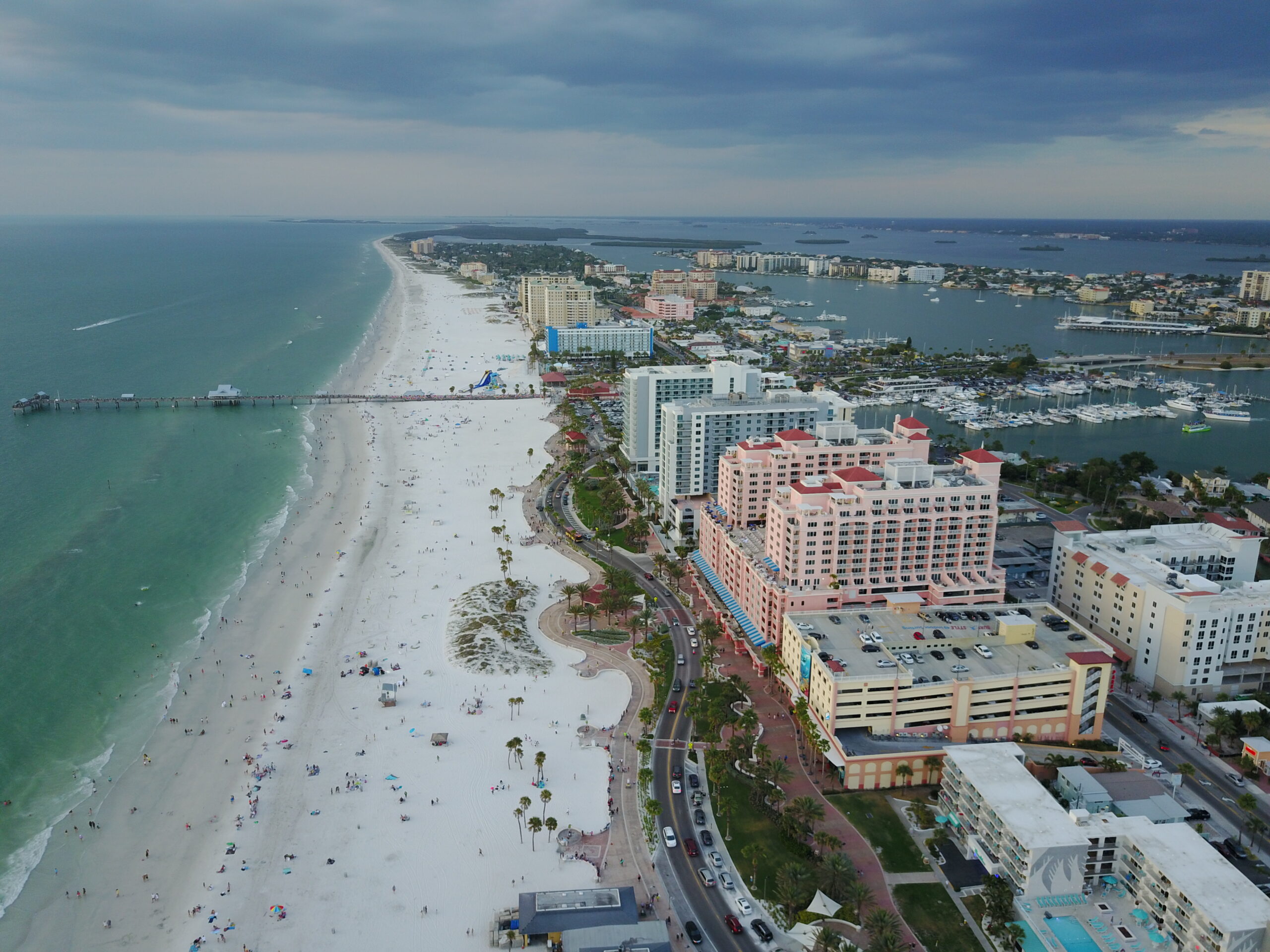
- The open Gulf beach is the safest bet. It's sand, not marsh, and it catches whatever breeze there is. Set up near the water rather than against the dunes and landscaping, where the air tends to be stiller.
- Bay-side docks and waterfront dining are likely buggier. Our wind sensor is on the Gulf side, so we can't measure the harbor, but it's sheltered from the Gulf breeze. If a bay-side sunset table is the plan, bring repellent.
- Mangrove and marsh shorelines are the worst. These are the breeding grounds. A paddle on the mangrove trails, as in our Clearwater kayaking guide, or an evening on the bay side of Caladesi Island or Honeymoon Island, calls for repellent and long sleeves, especially late in the day. The same goes for a night bioluminescence paddle.
- Remote islands at sunset. Our Three Rooker Island guide passes on the Friends of Anclote Key's warning that nearby Anclote Key is “well known for its biting gnats” and mosquitoes. Staying late on any undeveloped island? Pack spray.
- Around buildings and rentals. This is Aedes aegypti territory. Pinellas County says the species lives in man-made containers, is active by day and in the evening, and is the most common mosquito its technicians find at service requests.
UF/IFAS says regular window screens don't keep biting midges out, and a UF/IFAS entomologist suggested large electric fans to blow these weak fliers off patios and decks. In a hotel, close the balcony door at dusk, and if your balcony or lanai has a fan, run it while you sit out.
Does Clearwater Beach have sand fleas?
Not a flea that lives in the sand and bites you, no. The name gets used for two different things:
- Biting midges. UF/IFAS lists “no-see-ums, sand flies, or sand gnats” as names for them. UF/IFAS says many species are under about 1 mm long, small enough to go unseen. Itchy bites from a sunset on the sand, with nothing visible doing the biting, usually point to these. UF/IFAS says the discomfort usually lasts minutes to hours, and people who are hypersensitive may itch for two to three days.
- Beach hoppers. UF/IFAS says amphipods “like those called beach fleas” live on the beach under stones or decaying vegetation. These small crustaceans are mostly scavengers, and UF/IFAS doesn't describe them as biters. Spread your towel away from the seaweed and you'll mostly avoid them.
For the bigger creatures on the island, from shorebirds to dolphins, see our Clearwater Beach wildlife guide.
When are lovebugs and the swarms of black bugs around?
Lovebugs are small black flies with a red thorax, often seen flying in mating pairs. UF/IFAS's Featured Creatures profile says Florida has two generations a year, each lasting about four weeks, in April to May and August to September. Adults have been collected in every month except November, but those two flights are the ones you'll notice. A 2026 UF/IFAS release calls them a harmless nuisance: adults live a few days, and swarms last only a few weeks in any one place.
You'll see more of them on the drive in than on the sand. UF/IFAS says they're drawn to highways and car exhaust. Males hover in swarms from about 8 to 10 a.m. and again from about 4 or 5 p.m. until about 8 p.m., and mating pairs start their dispersal flights around 9 to 11 a.m. Their remains are slightly acidic and can etch car paint if left for days. The profile recommends soaking with water for about five minutes and then scrubbing.
Clouds of small black bugs on buildings are usually something else. Pinellas County's mosquito FAQ says these are likely aquatic midges, “most common from April through November,” and that they are “completely harmless and do not bite.”
If you're visiting in the hot months, our Clearwater Beach in summer guide covers the heat, afternoon storms and other summer logistics, and our rainy-day guide has indoor plans for a stormy or buggy evening.
Which bug repellents actually work?
CDC recommends EPA-registered insect repellents with one of these active ingredients:
- DEET
- Picaridin (called KBR 3023 or icaridin outside the US)
- IR3535
- Oil of lemon eucalyptus (OLE) or para-menthane-diol (PMD)
- 2-undecanone
Pinellas County names the first four in its dengue guidance. For no-see-ums specifically, UF/IFAS says DEET-based repellents commonly used against mosquitoes “are also the main repellent used to repel biting midges.”
CDC's rules for using them:
- If you use sunscreen, put it on first and repellent second.
- Don't use products containing OLE or PMD on children under 3. For more on beach days with a baby or toddler, see our toddler guide.
- For a child's face, put repellent on your own hands first, then apply it.
- Permethrin goes on clothing and gear only, never on skin.
As for natural sprays, CDC says it doesn't know how well non-registered repellents work, including some natural ones. EPA says products in its exempt “minimum risk” category “have not been evaluated for effectiveness.” Registered products have been evaluated for safety and effectiveness when used as labeled. EPA's repellent search tool lets you look up registered products by active ingredient and protection time.
Pinellas County Mosquito Control's FAQ also covers two popular gadgets. Bug zappers don't control mosquitoes, because mosquitoes need more than light to be drawn in. Citronella plants contain chemicals that repel mosquitoes, but the county says they aren't released unless the plant is damaged, so a potted plant on the table won't do much.
Pinellas County's “Dress” step is light-colored long sleeves and pants, plus socks and closed-toe shoes when practical. UF/IFAS gave similar advice for no-see-ums in 2005: long sleeves, long pants and a DEET repellent. On a mangrove paddle or at a bay-side dinner, that leaves less skin to spray.
Does Pinellas County spray for bugs, and who do you call?
Pinellas County Mosquito Control covers the whole county, including all 24 municipalities. It focuses on killing mosquitoes as larvae, using bacterial larvicides (Bti and Bs) and the growth regulator methoprene. The points that matter to visitors:
- No-see-ums aren't treated. The county's FAQ says: “We do not control spray for no-see-ums or other problematic insect species.” It treats mosquitoes because of their public health impact.
- Fogging happens overnight. Adult mosquito spraying is done only by truck-mounted ultra-low-volume foggers, between 2 and 6 a.m. The county says it never fogs on a fixed schedule or on request. Decisions are based on surveillance data. It doesn't spray liquid from the air. Its helicopter drops only granular larvicide.
- During the emergency, routine complaints are on hold. As of October 2026, the Mosquito Control page says “the County cannot provide services for routine mosquito complaints at this time” because of high viral activity. You can see completed and planned treatments on the county's treatment map.
- Contact: Pinellas County Mosquito Control, (727) 464-7503, mosquitocontrol@pinellas.gov, or the county's service request app.
In a vacation rental, you can do your part against the dengue mosquito. The county says mosquitoes need only a quarter inch of water to complete their life cycle. Tip out plant saucers, buckets and toys once a week, the same “Dump” step the county asks of residents.
We built the calm-evening table from NOAA NDBC wind files for station CWBF1 and archived the scripts so we can re-run them. Bug habits come from UF/IFAS Featured Creatures profiles, UF/IFAS news releases, and the 2018 Florida Mosquito Control white paper hosted by UF's Florida Medical Entomology Laboratory. Dengue figures come from Pinellas County, the Florida Department of Health's weekly arbovirus report for September 20 to 26, 2026, and DOH-Pinellas, and repellent guidance from CDC and EPA. All were checked October 4, 2026, and the dengue figures again on October 5. We didn't count bites or test repellents ourselves, and we don't give medical advice. We're an independent guide, and no business, agency or product named here pays us.
Frequently asked questions
Are there no-see-ums at Clearwater Beach?
Yes. Biting midges live along Florida's coast and breed in marshes, swamps and mangroves. They're worst at dawn and dusk on still evenings, and less of a problem on the breezy open Gulf beach than on the bay side or island trails. In 2005, a UF/IFAS entomologist put their biggest numbers in October and November and again in April and May.
Does Clearwater Beach have sand fleas?
Not biting fleas that live in the sand. Itchy bites blamed on “sand fleas” are often biting midges, which UF/IFAS also calls sand flies or sand gnats. The small crustaceans under the seaweed are amphipods, sometimes called beach fleas, which UF/IFAS describes as mostly scavengers.
Are there mosquitoes on Clearwater Beach?
Mosquitoes breed year-round in Pinellas County, according to the county. On the open sand a breeze usually keeps them down, but near buildings you can meet Aedes aegypti, which bites by day and in the evening. Black salt marsh mosquitoes come from coastal marshes, mostly bite at night, and are a bigger issue near mangroves.
Which months have the fewest calm, buggy sunsets?
No source counts bites by month, so we use wind as a proxy. In NOAA readings from 2019 to 2025, April and October had the fewest calm readings around sunset (about 7%), and May had 9%. August, December and July had the most (about 19 to 20%), so those are the months to pack repellent for sunset.
What are the black bugs at Clearwater Beach?
Black flies with a red thorax, often flying in pairs, are lovebugs. They're harmless and peak in April to May and August to September. Clouds of tiny black insects on buildings are likely aquatic midges, which Pinellas County says are harmless, don't bite, and are most common from April through November.
Is it safe to visit Clearwater during the dengue emergency?
We can't judge your personal risk. As of October 2, 2026, Pinellas County reported 13 locally acquired cases in the county, and none of the county or state pages we read advises against travel. The county's guidance is to dump standing water, cover up day and night, and use a repellent with a CDC-recommended ingredient. For health questions, see the Florida Department of Health's dengue page.
Does bug spray work on no-see-ums?
UF/IFAS says DEET-based repellents are the main repellent used against biting midges. For mosquitoes, CDC also recommends picaridin, IR3535, oil of lemon eucalyptus, PMD and 2-undecanone. Long sleeves and a fan help too, because no-see-ums are weak fliers.
Sources
- NOAA National Data Buoy Center, Station CWBF1, 8726724 Clearwater Beach, FL (location, site elevation, anemometer height). ndbc.noaa.gov
- NOAA NDBC, historical standard meteorological data files cwbf1h2019 to cwbf1h2025, retrieved October 4, 2026. ndbc.noaa.gov
- NOAA NDBC, Measurement Descriptions and Units (UTC times, wind averaging). ndbc.noaa.gov
- Pinellas County, Mosquito-transmitted Dengue Fever: What you need to know (updated 10/2/2026). pinellas.gov
- Pinellas County, Mosquito Control (alert, service requests, contact, FDOH referral). pinellas.gov
- Pinellas County, Frequently Asked Questions: Mosquito (fogging, no-see-ums, aquatic midges, zappers, citronella). pinellas.gov
- Pinellas County, Mosquito Prevention and Protection Tips (Aedes aegypti, year-round breeding, 3 Ds). pinellas.gov
- Pinellas County, mosquito treatment map. experience.arcgis.com
- Florida Department of Health, Florida Arbovirus Surveillance, Week 38: September 20-26, 2026. floridahealth.gov
- Florida Department of Health, Dengue Fever. floridahealth.gov
- Florida Department of Health in Pinellas County, DOH-Pinellas Issues Mosquito-Borne Illness Alert, August 11, 2026. pinellas.floridahealth.gov
- UF/IFAS, EENY 349/IN626, Biting Midges, No-See-Ums Culicoides spp. (Burkett-Cadena, Cooper, Addae, Connelly and Buckner). ask.ifas.ufl.edu
- UF/IFAS, EENY 47/IN204, Lovebug Plecia nearctica Hardy. ask.ifas.ufl.edu
- UF/IFAS, EENY-434/IN792, Yellow Fever Mosquito Aedes aegypti. ask.ifas.ufl.edu
- UF/IFAS, EENY591/IN1035, Black Salt Marsh Mosquito Aedes taeniorhynchus. ask.ifas.ufl.edu
- UF/IFAS, EENY-220/IN377, Terrestrial Amphipods or Lawn Shrimp. ask.ifas.ufl.edu
- UF/IFAS News, Fewer Biting Midges Expected This Fall, Thanks To Summer Rains, Says UF Expert, September 29, 2005. blogs.ifas.ufl.edu
- UF/IFAS News, Lovebugs are back! But experts say the familiar Florida pest is a harmless nuisance, May 19, 2026. blogs.ifas.ufl.edu
- Florida Coordinating Council on Mosquito Control, Florida Mosquito Control 2018 white paper (hosted by UF/IFAS Florida Medical Entomology Laboratory). fmel.ifas.ufl.edu
- CDC, Preventing Mosquito Bites (repellent active ingredients, children, sunscreen order, permethrin). cdc.gov
- CDC, Dengue. cdc.gov
- EPA, Regulation of Skin-Applied Repellents (registered vs. minimum-risk products). epa.gov
- EPA, Find the Repellent that is Right for You (search tool). epa.gov
- Friends of Anclote Key State Park & Lighthouse (biting gnats and mosquitoes on Anclote Key). anclotecso.org
Planning your evenings on the sand?
Pick the open Gulf beach for sunset, pack a registered repellent, and save the mangrove paddles for breezy mornings.
Plan your visit