
Rarely on the Gulf beach itself. The glow near Clearwater comes from summer blooms of the plankton Pyrodinium bahamense in upper Old Tampa Bay, around Safety Harbor and Cooper's Bayou, a 20-minute drive east. In 26 years of county samples, August turned up the plankton in 17 years and July in 14. County samples found none from January 2024 through August 2026, though, and LED kayak tours light the water with bulbs, not plankton.
Key takeaways
- The Florida Fish and Wildlife Conservation Commission (FWC) sampled Pier 60 on September 21 and 28, 2026 and found no Pyrodinium. The open Gulf beach isn't where this plankton blooms.
- FWC says the high-biomass blooms form in Old Tampa Bay, the upper bay that takes in Safety Harbor, Oldsmar and Cooper's Bayou.
- A Tampa Bay Estuary Program (TBEP) report says blooms generally run mid-May to late September. Our count of 2000 to 2025 samples puts the peak in July and August.
- The last three summers were quiet. TBEP's provisional 2025 report card calls Pyrodinium blooms significantly smaller, and the county's 18 Old Tampa Bay stations recorded none from January 2024 through August 2026.
- A tour that says "glow" often means LED lights. The straight-talking ones say natural glow is possible, not promised.
Does the water at Clearwater Beach glow at night?
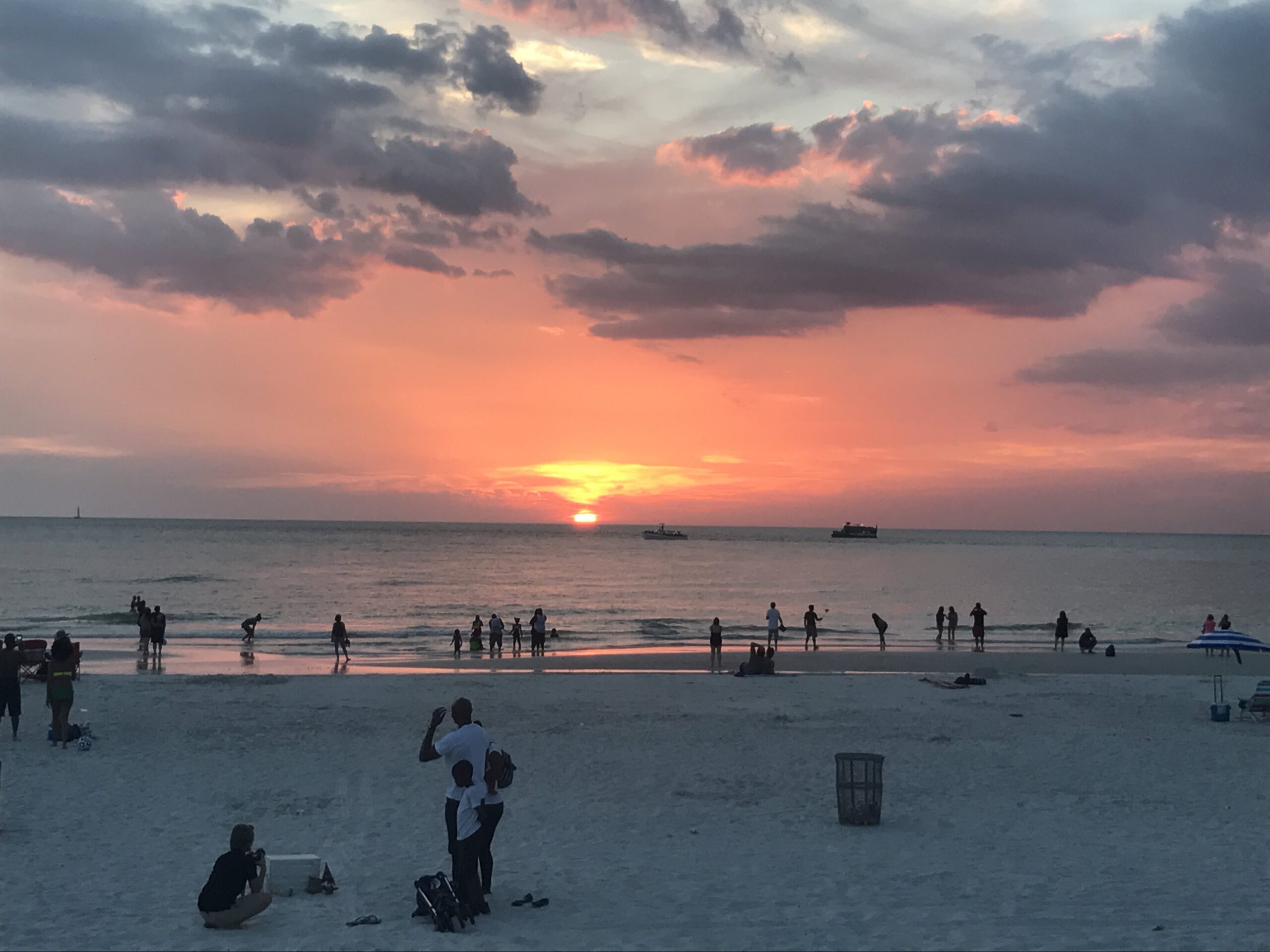
Not in any way you can count on. Tampa Bay's main glow-maker, a single-celled dinoflagellate called Pyrodinium bahamense, blooms in the upper bay. FWC's Old Tampa Bay monitoring page says cells occasionally turn up in lower Tampa Bay, but high-biomass blooms form in Old Tampa Bay, where circulation is more restricted. Clearwater Beach faces the open Gulf, and FWC's two most recent samples at Pier 60, on September 21 and 28, 2026, found none.
The Gulf coast can still sparkle now and then. Other dinoflagellates can light up a beach for a night or two when they bunch up. In September 2023, WTSP ran a photographer's pictures of blue glow at Bean Point on the north tip of Anna Maria Island, about 30 miles south as the crow flies. She'd gone out to shoot the Milky Way. Events like that are short and unpredictable, and we found no agency that logs them. For what does change the Gulf water from day to day, see why Clearwater's water looks clear or murky.
What makes Tampa Bay glow?
Mostly Pyrodinium bahamense. FWC says it blooms most often in summer in Tampa Bay and the Indian River Lagoon because, as a tropical and subtropical species, its growth is closely tied to temperature. It spends the winter as a seed-like cyst on the bay floor. A study by FWC scientists and partners, summarized by TBEP, found Old Tampa Bay cysts beginning to germinate by February and germinating at their maximum by April. It says blooms generally begin by mid-May and end by late September.
Glow needs a crowd. In a 2003 Bay Soundings article on Tampa Bay bioluminescence, Karen Steidinger, then a senior research scientist at the Florida Marine Research Institute, explained that the right organism has to multiply above its normal background level, and something usually has to disturb the water. She named Pyrodinium, Noctiluca and several other dinoflagellates as likely local sources, with the best chance at night from summer through fall.
Comb jellies are the other glowing animal people mention. Visit Florida gives them a November-through-May season. We found no agency or news record of comb-jelly glow near Clearwater.
Which months does Old Tampa Bay bloom? 26 years of county samples
No agency counts glowing nights. The Environmental Protection Commission of Hillsborough County (EPC) does count the plankton, though, at 18 fixed Old Tampa Bay stations, sampled about once a month, with records going back to the 1970s. We pulled every sample from 2000 through 2025 and asked one question for each month: in how many of those 26 years did at least one station find Pyrodinium? The last column narrows it to the three stations closest to Safety Harbor Marina and Cooper's Bayou Park, where the local tours launch.
| Month | Years with Pyrodinium found, any of 18 stations (of 26) | Years at 100,000+ cells per liter | Station-samples with Pyrodinium | Near Safety Harbor and Cooper's Bayou (found / 100,000+) |
|---|---|---|---|---|
| January to April | 1 (January 2017 only) | 0 | 1 of 1,798 | 0 / 0 |
| May | 3 | 1 | 1.3% | 2 / 1 |
| June | 10 | 6 | 8.9% | 8 / 5 |
| July | 14 | 10 | 22.0% | 13 / 7 |
| August | 17 | 16 | 35.8% | 15 / 11 |
| September | 14 | 8 | 24.2% | 12 / 6 |
| October | 5 | 1 | 2.3% | 3 / 1 |
| November and December | 0 | 0 | 0 of 925 | 0 / 0 |
| Darkest summer 2027 nights | New moons (USNO, Eastern time): May 6, June 4, July 3, Aug. 2, Aug. 31, Sept. 29 | |||
Aim for August, with July and September close behind. Across the full record, 19 of the 26 years had Pyrodinium in at least one sample, and 17 reached at least 100,000 cells per liter, the level where FWC's bloom data starts its top two categories. The highest single count was 4.4 million cells per liter in July 2020, at station 46 off Safety Harbor.
The catch is that the bloom has gone quiet. Here are the most recent summers:
| Year | Months with Pyrodinium in EPC samples | Highest count (cells per liter) |
|---|---|---|
| 2019 | June to September | 2.66 million (July) |
| 2020 | June to September | 4.4 million (July) |
| 2021 | June to September | 1.81 million (September) |
| 2022 | July to September | 1.49 million (July) |
| 2023 | May to August | 1.19 million (May) |
| 2024 | None | None found |
| 2025 | None | None found |
| 2026 (January to August) | None | None found |
TBEP's provisional 2025 water quality report card, presented in December 2025, points the same way: it says Pyrodinium blooms were significantly smaller in the last three years. Smaller isn't gone. A bloom can form between monthly samples, which is one reason FWC runs its own Old Tampa Bay sampling twice a month from April through September. Still, if you're planning summer 2027 around glowing water in Tampa Bay, know that the recent run has been poor. For the rest of a July or August trip (heat, storms, crowds), see our guide to Clearwater Beach in summer.
Data: the EPC phytoplankton cell-count file (PlanktonDataList_ThroughCurrentReportMonth), downloaded through the public link that TBEP's open-source tbeptools package uses, retrieved October 5, 2026, with data through August 2026. We kept the 18 stations EPC labels Old Tampa Bay (about 216 station-samples a year). Date range: January 2000 to December 2025 for the monthly table, plus January to August 2026. Rules: a month counts for a year if any sample that month recorded Pyrodinium bahamense. EPC counts cells in 0.1 milliliter, so the smallest number the file can record is 10,000 cells per liter. That is already above the 5,000 cells per liter that the TBEP report defines as a bloom. The near-shore column uses stations 46, 64 and 65, the three closest to Safety Harbor Marina and Cooper's Bayou Park. Limits: one sample per station per month can miss a short bloom, and cell counts measure plankton, not how bright the water looks. New moon dates: U.S. Naval Observatory, converted to Eastern Daylight Time.
Where has glowing water actually been reported near Clearwater?
A plankton count isn't a glowing wake, so we also went looking for on-the-record reports near Clearwater. These are the ones we could tie to a dated source.
| When | Where | What was reported | Source |
|---|---|---|---|
| Late 1990s, recalled in 2003 | The pass near Honeymoon Island, Dunedin | Glow around fishing lures on an incoming tide, May 31, the last day of snook season. The writer said he'd seen it a handful of times while night kayaking in Tampa Bay. | Bay Soundings, Summer 2003 (interview with St. Petersburg Times outdoors writer Terry Tomalin) |
| June 2021 | Old Tampa Bay | Pinellas County said a bloom there was not red tide but a seasonal Pyrodinium bloom. A bloom report, no glow mentioned. | Tampa Bay Times, June 30, 2021 |
| Summer, ongoing (article updated Sept. 2025) | Safety Harbor and Cooper's Bayou Park | Guided bioluminescent tours into Safety Harbor from late June to late August, and paddlers reporting glow at Cooper's Bayou | Visit Florida |
| Saturday, Sept. 9, 2023 | Bean Point, Anna Maria Island (north tip, about 30 miles south) | Photos of blue glow in the water, taken by a photographer out to shoot the Milky Way | WTSP, Sept. 12, 2023 |
| Friday, Aug. 2, 2024 | R.E. Olds Park, 107 Shore Dr. W., Oldsmar | TBEP, ECOmersion and Tampa Bay Waterkeeper led a free evening paddle described as going "through the bioluminescence in Old Tampa Bay" | TBEP event page |
None of these comes from the Clearwater Beach sand. The August 2024 paddle also fell in a summer when EPC's monthly samples found no Pyrodinium, and we couldn't find a published account of what paddlers saw that night.
Is anything blooming right now?
Not near Clearwater. FWC's harmful algal bloom database for September 21 to October 1, 2026 shows 13 samples in Old Tampa Bay and Safety Harbor. Two had any Pyrodinium, and neither topped 667 cells per liter. In Clearwater Harbor, the only hit was a trace (333 cells per liter) at the Dunedin Municipal Marina on September 28. Over on the Space Coast, the Indian River Lagoon was still blooming: 24 of 28 Brevard County samples were positive, and one near the Pineda Causeway hit about 2.5 million cells per liter on September 28. Check FWC's Pyrodinium current-status map before you plan a night paddle. When we pulled its data, it covered roughly the previous two weeks of samples.
Which night tours promise glow, and which are just LED lights?
Search "bioluminescence Clearwater" and two different products come up mixed together. Some tours paddle where natural glow is possible. Others put LED lights under clear or glass-bottom kayaks, which has nothing to do with plankton. The table sums up what each operator's own page says. We quote their claims without endorsing them.
| Operator and launch | What it advertises | Price and timing (as of October 2026) |
|---|---|---|
| Get Up and Go Kayaking, Glow Tour. Cooper's Bayou Park, 709 N. Bayshore Blvd., Clearwater | Clear kayaks with color-changing LEDs that stay on "regardless of whether bioluminescence is present." Guides switch them off mid-tour to check for glow. The page says it can't guarantee bioluminescence on any given night. | $64 a person; departs 9:30 p.m.; about 1 hour; ages 12+; 10 guests max |
| Happy Goat Adventures, bioluminescent paddleboard tour. Cooper's Bayou Park | Paddleboard tour with a stop to swim in the glow, and a note that glow is "not always a guarantee" | $65; about 90 minutes; 4 to 15 people. No dates were posted when we checked. |
| Tocobaga Tours. Safety Harbor Marina, 110 Veterans Memorial Ln., Safety Harbor | Bioluminescent night kayaking listed as offered May to August | $60 a person. The site's banner still reads "Summer 2022," so call to confirm. |
| Wandering Adventures Kayak Tours, a St. Petersburg outfitter. Safety Harbor tours | Visit Florida describes its Safety Harbor tours as running late June to late August, three to five nights a week | Its booking page listed no bioluminescence tour in October 2026, which fits the season. |
| Sharkey's Glass Bottom Tours, "Clearwater Beach" night tour. County of Pinellas Boat Ramp, 18651 Gulf Blvd., Indian Shores | LED-illuminated fish feeding from glass-bottom kayaks. Its page makes no bioluminescence claim. | From $62; 60 to 75 minutes; ages 3+; $2 parking |
Mind the meeting points. The "Clearwater Beach" LED tour meets at a county ramp in Indian Shores (Google lists the address as Indian Rocks Beach), about 10 road miles and 25 minutes south of Pier 60. Every natural-glow tour we found launches from Cooper's Bayou or Safety Harbor, about 9.5 to 11 road miles and 20 minutes east of the beach. Both are bay-side launches at dusk, when biting insects are at their worst, so read our guide to no-see-ums, mosquitoes and repellent for a night paddle before you go. If you'd rather paddle in daylight, our guide to kayaking around Clearwater Beach covers the mangrove trails and rentals, and things to do in Clearwater Beach at night has evening plans that don't depend on plankton.
Pick a July or August date within a few days of a new moon, book a tour that launches from Cooper's Bayou or Safety Harbor, and check the FWC map that week. If Old Tampa Bay shows little or no Pyrodinium, treat the trip as a night paddle with an outside chance of glow. Glow only shows once it's fully dark, so check how late it gets dark each month when you pick a start time.
Is the Space Coast worth the drive for brighter glow?
In summer, if glowing water is the whole point, yes. FWC monitors Pyrodinium in both Tampa Bay and the Indian River Lagoon because both see annual blooms, and its late-September 2026 samples show the lagoon still blooming while Old Tampa Bay sat near zero. Visit Florida says most of the state's bioluminescent paddling happens on the northern Space Coast, and it calls July and August the prime months for Central Florida.
The price is distance. Titusville's Parrish Park is about 150 road miles from Pier 60, a little over three hours each way before traffic. That's an overnight, not an evening. If you're already weighing the other coast, our Clearwater Beach vs Cocoa Beach comparison covers the trade-offs, and a Space Coast night could pair with a launch (see seeing a rocket launch from Clearwater Beach).
Is glowing water safe, and what about shellfish and fish?
The plankton that makes the glow also makes a toxin. FWC says Pyrodinium produces saxitoxin, and that toxic blooms can contaminate fish and shellfish. Saxitoxin causes paralytic shellfish poisoning. FWC lists the symptoms as numbness or tingling of the mouth and lips, nausea, vomiting, drowsiness, muscle weakness, incoherent speech and trouble breathing. FWC and the Florida Department of Health both say puffer fish can carry it too, and FWC adds that cooking or cleaning the fish won't destroy the toxin.
- Shellfish: harvest only from areas the Florida Department of Agriculture and Consumer Services (FDACS) classifies as Approved or Conditionally Approved, and only when they're in open status. FDACS says harvesting is not allowed in Restricted, Prohibited or unclassified waters. Check the FDACS shellfish harvesting area status first. Bay scallops have their own rules; see our guide to scallop seasons and closures near Clearwater.
- Puffer fish: FWC rule 68B-3.007 bans taking puffers in Volusia, Brevard, Indian River, St. Lucie and Martin counties, which covers the Space Coast glow spots. Pinellas isn't on that list, but the saxitoxin warnings still apply.
- Health problems from marine algal toxins: FWC directs people to the Florida Poison Information Center at 1-800-222-1222.
FWC's Pyrodinium pages are about eating contaminated seafood. They don't address swimming or paddling in a bloom, and we won't guess past them. Our red tide guide covers the different algae that affect the Gulf beaches.
FWC's rules for kayaks, canoes and paddleboards require a lantern or flashlight showing a white light between sunset and sunrise, a Coast Guard-approved wearable life jacket for each person (worn by children under 6), and a whistle or horn. Bring a light even if you plan to switch it off to look for glow, and check the posted hours at your launch before you go.
Bloom figures come from EPC and FWC data, health and harvest rules from the FWC, FDACS and Department of Health pages below, and operator details from each operator's own site, checked October 4 and 5, 2026. We haven't taken these tours or gone out looking for glow ourselves. We're an independent guide, and no business named here pays us.
Frequently asked questions
Does Clearwater Beach have bioluminescence?
Not reliably. The glowing plankton blooms in upper Old Tampa Bay, around Safety Harbor and Cooper's Bayou, about 20 minutes' drive east. FWC's late-September 2026 samples at Pier 60 found none, and glow on the Gulf beaches is rare and brief.
What is the best month to see bioluminescence in Tampa Bay?
August. In county samples from 2000 to 2025, Old Tampa Bay had Pyrodinium in August in 17 of 26 years, followed by July and September at 14 each. A TBEP report says blooms generally run mid-May to late September. Choose a night near the new moon.
Is the bioluminescence in Tampa Bay still happening?
It has faded lately. TBEP's 2025 report card says Pyrodinium blooms were significantly smaller in the last three years, and EPC's monthly samples found none in Old Tampa Bay from January 2024 through August 2026. Blooms can still pop up between samples, so check FWC's current-status map before you go.
Are LED kayak tours the same as bioluminescence tours?
No. LED tours light the water with lamps under clear or glass-bottom kayaks, plankton or not. Natural glow needs a bloom. One Cooper's Bayou tour uses LEDs and switches them off mid-tour to check for real glow, which it doesn't guarantee.
Can you swim in bioluminescent water near Clearwater?
One Cooper's Bayou paddleboard operator advertises a swim stop. FWC's Pyrodinium guidance covers eating shellfish and puffer fish, which can carry saxitoxin, and doesn't address swimming, so we don't make a call. Never eat shellfish from waters FDACS hasn't opened for harvest.
Sources
- Florida Fish and Wildlife Conservation Commission, Old Tampa Bay Monitoring Program (bloom location, timing, saxitoxin, sampling schedule). myfwc.com
- FWC, Research on the Life Cycle of Pyrodinium bahamense (saxitoxin, monitoring in Tampa Bay and the Indian River Lagoon). myfwc.com
- FWC, Seafood Poisoning Syndromes Caused by Toxic Algae in Florida (PSP symptoms, Poison Information Center). myfwc.com
- FWC, Puffer Fish Prohibition, rule 68B-3.007. myfwc.com
- FWC, Human-Powered Vessels (lighting, life jackets, sound devices). myfwc.com
- FWC, Pyrodinium bahamense Current Status map and HAB Database results, samples September 21 to October 1, 2026, retrieved October 5, 2026. gis.myfwc.com
- Tampa Bay Estuary Program, Algae Blooms (recurring summer Pyrodinium blooms in Old Tampa Bay over 20 years). tbep.org
- Lopez et al., Pyrodinium bahamense Seeding Potential in Tampa Bay: Executive Summary (bloom timing, 5,000 cells per liter bloom definition). tbep.org
- TBEP, 2025 Provisional Water Quality Report Card presentation. tbep-tech.github.io
- Environmental Protection Commission of Hillsborough County, phytoplankton cell counts, 1975 to August 2026, retrieved October 5, 2026, via the TBEP tbeptools import link. tbep-tech.github.io
- TBEP, ECOmersion and Tampa Bay Waterkeeper, Old Tampa Bay Bioluminescence Paddle event listing, August 2, 2024. TBEP registration page
- Visit Florida, Bioluminescent Kayaking in Florida (published October 2021, updated September 2025). visitflorida.com
- U.S. Naval Observatory, Phases of the Moon, 2027. aa.usno.navy.mil
- Florida Department of Agriculture and Consumer Services, Shellfish Harvesting Area Information. fdacs.gov
- Florida Department of Health, Eating Healthy Seafood (puffer fish and saxitoxin). floridahealth.gov
- Operator pages, checked October 4 and 5, 2026: Get Up and Go Kayaking Glow Tour; Happy Goat Adventures; Tocobaga Tours; Wandering Adventures booking page; Sharkey's Glass Bottom Tours and its meeting locations.
- "Fireflies in Tampa Bay? Flashy critters light up the water," Bay Soundings, Summer 2003.
- "Red Tide levels receding in Pinellas County," Tampa Bay Times, June 30, 2021.
- "Photos: Bioluminescence seen in waters off Anna Maria Island in Manatee County," WTSP, September 12, 2023.
- Road distances and drive times from Pier 60: OpenStreetMap-based routing (OSRM), October 2026. Estimates only; traffic not included.
Planning a summer night on the water?
Pair a July or August paddle on the bay side with a beach day. Our trip planner covers the rest.
Plan your visit