
Yes, if it launches in the dark. Cape Canaveral's pads sit about 143 miles from Pier 60, bearing 71 to 76 degrees (east-northeast), so a rocket shows up as a moving light low over the mainland, not over the Gulf. Of the 82 Florida launches from October 2025 through September 2026, 43 lifted off with the sun more than 6 degrees below the horizon at Clearwater. Daytime launches are hard to spot from this far away.
Key takeaways
- Look east-northeast, over the mainland. The Gulf is the wrong way.
- Night launches are the ones worth staying up for. In the last 12 months, 37 of 82 Florida launches went up in full darkness at Clearwater and 6 more in deep twilight.
- You won't see liftoff. From 143 miles away the rocket has to climb a little over 2 miles just to clear the sea-level horizon, so the light shows up after T-0.
- Florida's launch pace has dropped. Eleven launches in November 2025 became one in September 2026, after SpaceX said its Florida Starlink missions would move from Falcon 9 to Starship.
- Launches slip and scrub all the time, and clouds anywhere between you and the Cape can hide one. Treat a sighting as a bonus, never a plan.
Can you actually see a Cape Canaveral launch from Clearwater Beach?
Yes, at night and with clear skies. The pads at Cape Canaveral Space Force Station and Kennedy Space Center are about 143 miles away on the Atlantic coast, too far to see the rocket leave the pad. On a clear night you see the exhaust once the rocket climbs above your horizon: a bright point rising slowly, low in the east-northeast, that can stay in view for several minutes while the engines burn. In daylight that flame competes with a bright sky. We don't count daytime launches as visible in the table below, and you shouldn't plan around one.
If a close-up launch is the reason for your trip, stay on the Atlantic side. Our Clearwater Beach vs Cocoa Beach comparison covers that trade-off.
How many Florida launches could you have seen in the last 12 months?
This table takes every launch from Cape Canaveral and Kennedy between October 1, 2025 and September 30, 2026 and sorts it by where the sun was at Pier 60 at liftoff. "Dark sky" means the sun was more than 6 degrees below the horizon, where civil twilight ends. Months are in Eastern time.
| Month | Florida launches | Daylight | Civil twilight (sun 0-6° below) | Dark twilight (sun 6-18° below) | Full night | Dark-sky launches | Dark-sky, no cloud ceiling at PIE |
|---|---|---|---|---|---|---|---|
| Oct 2025 | 7 | 3 | 0 | 0 | 4 | 4 | 3 |
| Nov 2025 | 11 | 1 | 0 | 0 | 10 | 10 | 10 |
| Dec 2025 | 8 | 5 | 0 | 0 | 3 | 3 | 2 |
| Jan 2026 | 7 | 3 | 0 | 1 | 3 | 4 | 3 |
| Feb 2026 | 7 | 2 | 0 | 0 | 5 | 5 | 4 |
| Mar 2026 | 8 | 5 | 0 | 1 | 2 | 3 | 3 |
| Apr 2026 | 9 | 5 | 0 | 1 | 3 | 4 | 3 |
| May 2026 | 6 | 5 | 0 | 1 | 0 | 1 | 1 |
| Jun 2026 | 6 | 2 | 2 | 0 | 2 | 2 | 2 |
| Jul 2026 | 6 | 2 | 0 | 1 | 3 | 4 | 2 |
| Aug 2026 | 6 | 3 | 0 | 1 | 2 | 3 | 2 |
| Sep 2026 | 1 | 1 | 0 | 0 | 0 | 0 | 0 |
| 12 months | 82 | 37 | 2 | 6 | 37 | 43 | 35 |
About half of Florida's launches went up under a dark Clearwater sky. Of those 43, 27 flew between midnight and dawn and 16 between dusk and midnight; 25 were Starlink missions. November 2025 was the standout, with 10 dark-sky launches out of 11. The last column is a rough weather check. For 35 of the 43, the nearest report from St. Pete-Clearwater International Airport (PIE) showed no broken or overcast layer. Five had one, and three had no report within an hour of liftoff. It tells you nothing about clouds over the middle of the state, so read it as "the local sky wasn't socked in," not "this launch was visible."
Launch count. All launches worldwide from October 1, 2025 to September 30, 2026 (UTC) from the Launch Library 2 API (v2.3.0), filtered to Cape Canaveral SFS and Kennedy: 82 launches (the older v2.2.0 endpoint also gives 82). We reconciled them against Jonathan McDowell's independent GCAT launch log (dated October 2, 2026). GCAT has 83 Florida entries; the extra is a New Glenn that failed on the pad before launch on the evening of May 28, 2026 (Eastern time), which GCAT logs under a separate tag (2026-E01) rather than as a launch. The other 82 matched one-to-one, within 40 seconds. Both sources give 109 Florida launches for calendar 2025.
Sun rule. Sun altitude at Pier 60 (27.9772° N, 82.8289° W, OpenStreetMap) at each liftoff, using the NOAA Solar Calculator equations: daylight above -0.833°, civil twilight to -6°, dark twilight to -18°, full night below that. Spot checks against the U.S. Naval Observatory API agreed within 0.2°. Clouds. Nearest PIE report in the Iowa Environmental Mesonet ASOS archive, if within 60 minutes of liftoff. Retrieved October 4-5, 2026. Script and results are kept with our research files.
Why did Florida launches drop off in September 2026?
Both logs show the same slide: 11 Florida launches in November 2025, six a month from May through August 2026, and one in September (SES's O3b mPOWER satellites, at 2:49 p.m. on September 13). It isn't a data gap. SpaceX kept flying Starlink missions in September, just not from Florida: three Falcon 9s went up from Vandenberg in California and one Starship from Starbase, Texas.
Starlink made up 52 of the 82 Florida launches in our window, and the last Florida Starlink flight on a Falcon 9 lifted off at 5:33 a.m. on August 25, 2026. On September 5, 2026, Spaceflight Now quoted Kiko Dontchev, SpaceX's vice president for launch: "From here on, Starlink missions out of Florida will fly on Starship." The same report said SpaceX is building Starship launch towers at Launch Complex 39A and Space Launch Complex 37 and aims to fly its first Florida Starship mission before the end of 2026. Launch Library 2 shows no Starship launch from Florida through October 5, 2026.
Until Starship flies from the Cape, expect fewer Florida night launches than late 2025 delivered. Crew, cargo, government and commercial missions carry on: a Falcon Heavy carrying NROL-97 lifted off from LC-39A at 11:54 p.m. on October 1, 2026, in full darkness.
Which direction do you look, and how high?
East-northeast, over the mainland. All five Florida pads used in the last year sit within five degrees of one line. Bearings and distances are our great-circle calculations from Pier 60 to each pad's published coordinates.
| Pad | Used by | Launches, Oct 2025-Sep 2026 | Bearing from Pier 60 | Straight-line distance |
|---|---|---|---|---|
| Space Launch Complex 40, Cape Canaveral SFS | SpaceX Falcon 9 | 64 | 73° (ENE) | 143 miles |
| Launch Complex 39A, Kennedy Space Center | SpaceX Falcon 9 and Falcon Heavy | 8 | 72° (ENE) | 142 miles |
| Space Launch Complex 41, Cape Canaveral SFS | ULA Atlas V and Vulcan | 7 | 72° (ENE) | 143 miles |
| Launch Complex 36, Cape Canaveral SFS | Blue Origin New Glenn | 2 | 76° (ENE) | 143 miles |
| Launch Complex 39B, Kennedy Space Center | NASA SLS (Artemis II) | 1 | 71° (ENE) | 142 miles |
Point a phone compass (set to true north) at about 72 degrees. By our calculation the sun rises on that same bearing around May 1 and August 10; in October it rises about 20 to 30 degrees to the right of the launch line, in December about 45.
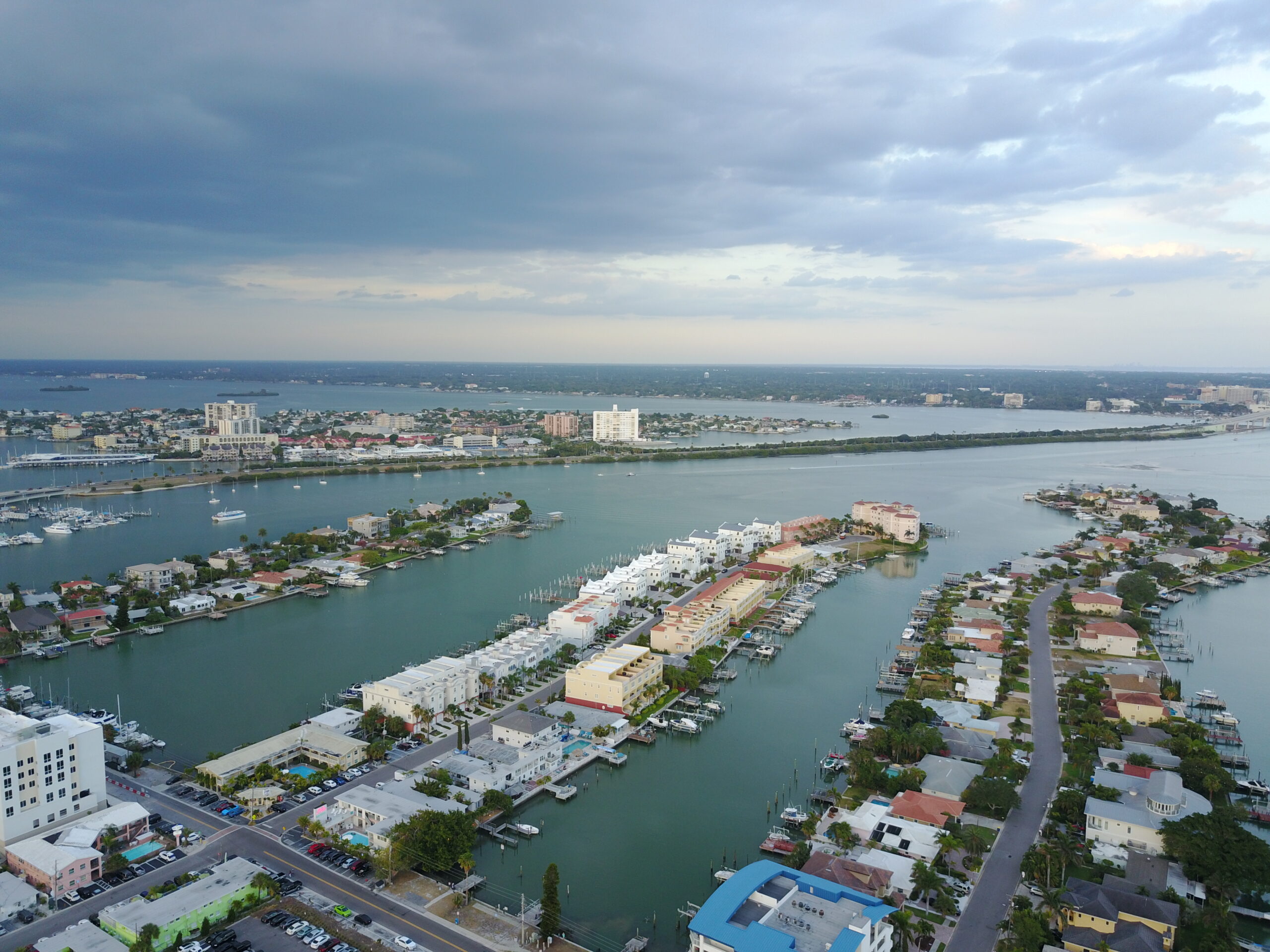
Now height. With standard atmospheric refraction, a rocket 143 miles away must be about 2.2 miles up just to touch the sea-level horizon, 4.7 miles up to sit 1 degree above it and about 7 miles up for 2 degrees. Even high up it stays low in your sky: a point 25 miles above the Cape would appear about 9 degrees up from Pier 60, roughly one fist at arm's length. Watch the band from the horizon to about two fists up.
How long after liftoff will you see it?
Not at T-0. At liftoff the rocket is below your horizon. It has to climb a couple of miles to show at all, then a few more to clear the haze, trees and buildings at the bottom of your view. Keep your eyes on the right patch of sky through the first few minutes.
The sample Falcon 9 timelines in SpaceX's Falcon User's Guide show what you're watching:
- Max Q (peak aerodynamic stress) at T+67 to 74 seconds.
- First-stage engine cutoff and stage separation at about T+145 to 151 seconds.
- Second-stage engine cutoff at T+484 to 514 seconds, a little over eight minutes in.
Those are SpaceX's sample profiles, and real missions vary, so follow the webcast clock.
What is a twilight "jellyfish" launch, and how often does one happen?
Shortly before sunrise or after sunset, you can be standing in the dark while the exhaust plume high above the rocket's path is still in sunlight. The lit plume spreads into a glowing cloud, the "jellyfish" people photograph.
How low the sunlight reaches depends on how far below the horizon the sun is. Simple geometry gives the height of Earth's shadow straight above a spot: about 22 miles up when the sun is 6 degrees below the horizon, 49 miles at 9 degrees, 88 miles at 12 degrees and 204 miles at 18 degrees. A plume above that line is lit. The rocket is well east of Clearwater by then, so the real numbers shift a little, but the rule holds: the closer to sunrise or sunset, the lower the sunlight reaches.
In our 12 months, eight Florida launches fell in that twilight band:
| Liftoff (Eastern time) | Mission | Pad | Sun below horizon at Pier 60 |
|---|---|---|---|
| Jan 18, 2026, 6:31 p.m. | Falcon 9, Starlink Group 6-100 | SLC-40 | 7.3° (evening) |
| Mar 4, 2026, 5:52 a.m. | Falcon 9, Starlink Group 10-40 | SLC-40 | 14.1° (morning) |
| Apr 27, 2026, 8:53 p.m. | Atlas V, Amazon Leo (LA-06) | SLC-41 | 11.2° (evening) |
| May 21, 2026, 6:04 a.m. | Falcon 9, Starlink Group 10-31 | SLC-40 | 7.7° (morning) |
| Jun 4, 2026, 6:26 a.m. | Falcon 9, Starlink Group 10-43 | SLC-40 | 2.5° (morning, civil twilight) |
| Jun 8, 2026, 6:13 a.m. | Falcon 9, Starlink Group 10-35 | SLC-40 | 4.8° (morning, civil twilight) |
| Jul 9, 2026, 5:25 a.m. | Falcon 9, Starlink Group 10-42 | SLC-40 | 15.3° (morning) |
| Aug 15, 2026, 9:12 p.m. | Falcon 9, Globalstar 2-R Mission 1 | SLC-40 | 13.8° (evening) |
That's fewer than one a month, and six of the eight were Falcon 9 Starlink missions, a kind of launch Florida no longer gets. The two June launches came with the Clearwater sky already brightening.
As of October 5, 2026, Launch Library 2 and the Space Coast Office of Tourism listed NASA's SpaceX CRS-35 cargo launch (Falcon 9) for Tuesday, October 13 at 6:33 a.m. Eastern. The sun would then be about 13 degrees below the horizon at Pier 60, squarely in the twilight band. Dates move, so check the night before.
Where should you stand in Clearwater to watch?
You need a low, open view to the east-northeast. From the Gulf-front sand you're looking back over the hotels, and by our geometry a 100-foot building 200 yards away blocks the lowest 9 or 10 degrees of sky, which is much of the sky a launch will cross.
- The harbor side of the island. Around Clearwater Beach Marina (25 Causeway Blvd, at the beach end of the Memorial Causeway) you look east across Clearwater Harbor toward the mainland, with water in front of you instead of towers. The marina is a short walk from Pier 60.
- An east-facing balcony or rooftop. A high floor facing the harbor clears the trees and rooftops on the far shore.
- The Tampa Bay shore, if you have a car. Spots on Old Tampa Bay with open water to the east-northeast, along the Courtney Campbell Causeway (SR 60) for example, give you a lower horizon. We couldn't confirm access hours for the causeway's shoreline, so obey posted signs.
- Not county parks after dark. Philippe Park in Safety Harbor (2525 Philippe Pkwy) faces Old Tampa Bay, but Pinellas County lists it as open 7 a.m. to sunset (as of October 2026). A park that closes at sunset is out for a night launch, so check the posted hours first. Our guide to beach and park hours after dark covers what stays open at night.
Get there 10 minutes before liftoff so your eyes can adjust, and turn your phone screen all the way down. The sun also rises over the mainland, so our Clearwater Beach sunrise guide points to the same harbor side. For more after dark, see Clearwater Beach at night.
Launches slip by minutes, days or weeks, and a clear sky in Clearwater doesn't mean a clear line of sight across the state. Recheck the time an hour before and keep a backup plan. Our weather by month guide covers the rainy season.
How do you find out when the next launch is?
Check an official schedule the night before and again an hour before liftoff.
- The Space Coast Office of Tourism launch schedule lists upcoming Florida launches with times. Entries far in the future are often placeholder dates.
- NASA's launch schedule covers NASA missions such as crew and cargo flights to the space station.
- SpaceX's launches page carries the launch time and the live webcast for its missions. The webcast clock is the best way to know where the rocket is in its climb.
Clearwater and the Space Coast share Eastern time, so there's nothing to convert.
Launch counts come from Launch Library 2 and the GCAT launch log, reconciled launch by launch. Sun positions, bearings, distances, horizon and shadow heights are our own calculations from published coordinates (SpaceX's Falcon User's Guide for SLC-40 and LC-39A, Launch Library 2 for the rest). Clouds come from the PIE weather station. We read the Space Coast Office of Tourism and NASA schedules and Pinellas County's park page in October 2026. We didn't watch these launches ourselves, and the data shows only when the sky was dark, not what anyone saw. We're an independent guide, and nobody named here pays us.
Frequently asked questions
Can you see a SpaceX launch from Clearwater Beach?
Yes, if it launches at night and the sky is clear across the state. Falcon 9 flew 70 of the 82 Florida launches from October 2025 to September 2026. Look east-northeast (about 72 degrees), low over the mainland, starting a little after liftoff.
Can you see a rocket launch from Tampa?
The same rules apply. By our calculation, downtown Tampa is about 122 miles from Space Launch Complex 40 at a bearing of 69 degrees, a little closer than Clearwater and in nearly the same direction. Look east-northeast, and plan around night launches.
How far is Clearwater Beach from Cape Canaveral?
About 143 miles in a straight line from Pier 60 to Space Launch Complex 40, and 142 miles to Launch Complex 39A at Kennedy Space Center, by our great-circle calculation from the pads' published coordinates. Driving is farther; see our Orlando to Clearwater Beach drive guide for the cross-state route.
What time of day is best for seeing a launch from the Gulf coast?
Night, and best of all the hour or so before sunrise or after sunset, when the high plume can catch sunlight while you stand in the dark. In daylight you're unlikely to pick out a rocket at this distance.
Sources
- The Space Devs, Launch Library 2 API v2.3.0, launches endpoint (all launches October 1, 2025 to September 30, 2026; Florida 2025 count; upcoming Florida launches), retrieved October 4-5, 2026. ll.thespacedevs.com
- Jonathan C. McDowell, General Catalog of Artificial Space Objects (GCAT), launch list launch.tsv, updated October 2, 2026. planet4589.org
- SpaceX, Falcon User's Guide, May 2025 (SLC-40 and LC-39A coordinates; sample Falcon 9 flight timelines). spacex.com
- NOAA Global Monitoring Laboratory, Solar Calculator and its published equations. gml.noaa.gov
- U.S. Naval Observatory, Astronomical Applications API (sun altitude spot checks). aa.usno.navy.mil
- Iowa Environmental Mesonet, ASOS archive, station PIE (St. Pete-Clearwater International Airport), October 2025 to September 2026. mesonet.agron.iastate.edu
- Florida's Space Coast Office of Tourism, launch schedule, accessed October 5, 2026. visitspacecoast.com
- NASA, launch schedule, accessed October 5, 2026. nasa.gov
- Pinellas County, Philippe Park (address and hours). pinellas.gov
- Statement by SpaceX vice president of launch Kiko Dontchev on Florida Starlink missions moving to Starship, and SpaceX's Florida Starship pad plans, as reported by Spaceflight Now, September 5, 2026.
- Pier 60 coordinates: OpenStreetMap (way 11250192), via Nominatim, October 2026.
Planning an evening around a launch?
Book a room at one of the harbor-side hotels if you can, and keep dinner plans flexible. Launch times move.
Plan your visit