
For stays under a month, book a hotel or a condo in a Tourist District ("T") building. Clearwater's code bars rentals shorter than 31 days or one calendar month in residential zones, so a nightly "Airbnb" in a residentially zoned condo or house may not be legal. Hotel or rental, stays of six months or less carry 13% tax (6% state, 1% county surtax, 6% tourist tax). Hotels usually win on 2 to 4 nights. A condo wins on a week or more with a group.
Key takeaways
- Clearwater bars rentals shorter than 31 days or one calendar month on residentially zoned property. Nightly stays belong in the Tourist District. Check any address on the city's zoning map and the state's vacation rental license database before you pay.
- Rentals of six months or less in Pinellas County carry 13% tax. Florida's rules say a required cleaning fee and a mandatory resort fee are both part of the taxable rent.
- A one-time cleaning fee hurts most on short stays. In our worked example it makes a condo about $100 dearer than a resort over 3 nights and about $105 cheaper over 7.
- City beach lots run 6 a.m. to 11 p.m. at $3.50 an hour, several ban parking overnight, and there's no public parking north of the Acacia roundabout. If you're driving, a rental without an assigned space is a problem.
Should you book a condo or a hotel at Clearwater Beach?
For most short trips, a hotel. It's legal wherever it operates, the quote covers most of what you'll pay (resort fees and parking aside), you can book two nights, and nobody hands you a checkout chore list. If your flight lands early or leaves late, see how early check-in and late checkout at hotels work, and compare that with the check-in and checkout times a rental host sets. A condo buys you space and a kitchen: two bedrooms, a living room, a washer, a fridge you can fill. That counts for more the longer you stay and the more people you bring.
On Clearwater Beach there's also a legal question. Condo buildings aren't all zoned alike, and in residential zones the city doesn't allow rentals of less than a month. Legal short-stay condos exist. You just have to confirm you're booking one.
| Your trip | Better pick | Why |
|---|---|---|
| Couple, 2 to 4 nights | Hotel | A cleaning fee spread over a few nights wipes out any nightly saving, and you won't use a kitchen much. |
| Family of 4, 5 nights | Close call | Roughly even on lodging cost in our example. A condo's kitchen and second bedroom are the tiebreaker. |
| Family or group of 5+, a week | Condo in a T-zoned building | One unit instead of two hotel rooms, the cleaning fee spread over 7 nights, and breakfasts at home. |
| Two or three weeks | Hotel or T-zoned condo | Residential condos can't legally rent for this length. Ask hotels for a weekly or monthly rate. |
| A month or more | Residential condo | This is what the 31-day rule allows. See our snowbird guide to monthly rentals. |
| Driving in with 2 cars | Rental with 2 assigned spaces, or a hotel that includes parking | City lots are no place to leave a car for a week, and resorts charge per vehicle. |
Where are nightly and weekly rentals legal on Clearwater Beach?
In buildings zoned Tourist ("T"). In residential zones, only for a month or longer. Three pieces of the city code set this up.
- The 31-day rule. Section 8-102 of the Community Development Code defines a residential use as "a permanent place of residence for a family." On residentially zoned property, it "shall not include rentals for periods of less than 31 days or one calendar month, whichever is less," or advertising for them. The residential districts are LDR, LMDR, MDR, MHDR, HDR and MHP.
- The Tourist District. "Overnight accommodations" (stays under 31 days or a calendar month) are a permitted use in the T District. That's where the hotels are, and a T-zoned condo building can legally rent by the night.
- What the city treats as evidence. Section 3-919 lists signs of an illegal short rental in a residential zone: a state transient-rental license or tax registration, vacation-rental advertising, overlapping leases shorter than a month, or using an agent to take bookings.
Florida law generally bars cities from regulating how long or how often a vacation rental can be rented (section 509.032(7)(b) of the Florida Statutes). The same paragraph exempts local rules adopted on or before June 1, 2011. Section 3-919's history notes ordinances from 2003 and 2009.
"Whichever is less" means a full calendar month counts even when it's shorter than 31 days, so renting all of February works. An 18-night stay written up as a "one-month lease" is the kind of arrangement Section 3-919 is aimed at.
1. Zoning. Ask for the street address and unit number, then search it on the City of Clearwater's zoning and parcel map. "T" means nightly stays are allowed by zoning. A residential code (LMDR, MDR, MHDR, HDR and so on) means a month minimum.
2. State license. Florida classifies a unit rented more than three times a year for less than 30 days as a transient public lodging establishment, and condo and house rentals in that class are licensed as vacation rentals by the Division of Hotels and Restaurants. The division publishes a searchable database of licensed vacation rental addresses that it says refreshes daily. A short-stay listing that isn't in it should get a question.
The condo association can be stricter than the city, with longer minimum leases, caps on rentals or tenant approval. Under section 718.110(13) of Florida's condo law, a new rental restriction binds only owners who agreed to it and later buyers, so two units in one tower can play by different rules. Ask the host for the association's rental rules in writing.
Which area should you rent in: North Beach, South Gulfview, Sand Key or Island Estates?
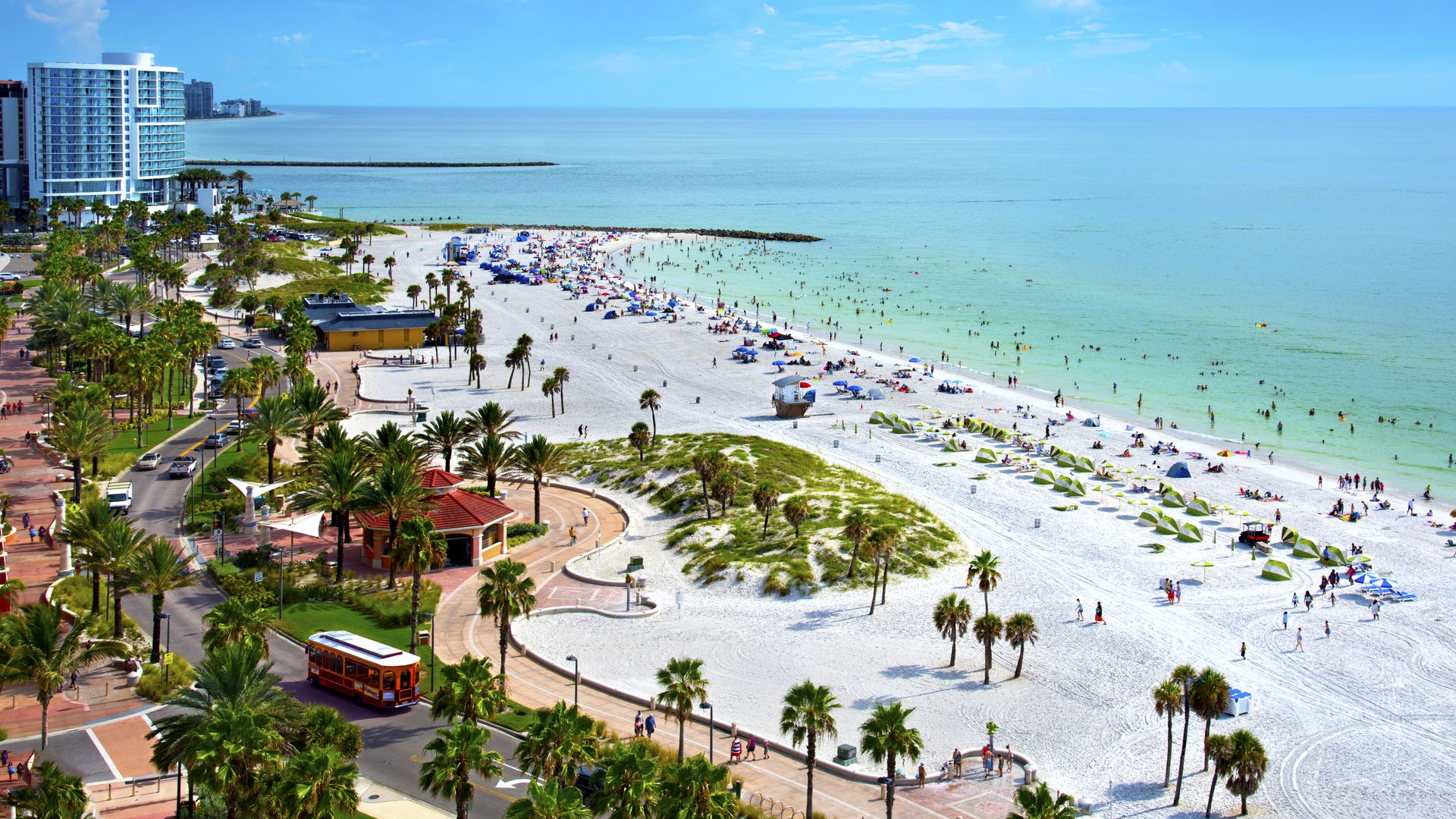
Rentals cluster in four areas. Zoning varies building by building, so use this table for the trade-offs and still check every address. Our Clearwater Beach neighborhood-by-neighborhood guide covers the feel of each neighborhood in more depth.
| Area | What you'll find | Walk to the sand | Parking reality | Watch for |
|---|---|---|---|---|
| North Beach (north of the Pier 60 area, along Mandalay Ave and Bay Esplanade) | Condos, small motels and low-rise rentals, with resorts such as Sandpearl Resort (500 Mandalay Ave) toward the south end | Short from the Gulf side; longer from the harbor side | No public parking north of the Acacia roundabout, per the city. You need an on-site space | Zoning changes block by block; check each address against the 31-day rule |
| South Gulfview (Pier 60 south toward Clearwater Pass) | Hotel towers and some condo buildings | Across the street or on the sand | Mostly garages; resort parking runs per night | Resort-style nightly fees in buildings run like hotels; noise near the Beach Walk |
| Sand Key (across Clearwater Pass) | Mostly high-rise condo towers, plus resort hotels | Gulf-front towers sit on the beach | Ask whether a garage or lot space is assigned to your unit | Only part of Sand Key is in Clearwater. South of the city limit, another town's rules apply |
| Island Estates (bay side, off the Memorial Causeway) | Houses and condos on canals, near the Clearwater Marine Aquarium | No. It's a drive, ride or long walk over the causeway bridge | Driveways at houses | Mostly homes; check zoning, since residential zones carry the month minimum. See our Island Estates guide |
Sand Key has a quieter beach and Sand Key Park at its north tip, but Pier 60 and most restaurants are across the bridge. The city code defines Sand Key as the part of the island inside Clearwater's city limits, between Clearwater Pass and the southern city line. If a listing's address is in another town, Clearwater's code isn't the one to check.
What does a rental really cost compared with a hotel?
Same tax, different fees. A hotel adds a nightly resort fee and parking. A rental adds a one-time cleaning fee, sometimes a platform or booking fee, and often a refundable damage deposit. The charges side by side, as of October 2026:
| Charge | Hotel | Vacation rental or condo |
|---|---|---|
| State sales tax on stays of 6 months or less | 6% | 6% |
| Pinellas discretionary surtax | 1% | 1% |
| Pinellas tourist development tax | 6% | 6% |
| Resort or amenity fee | $35 a night at Sandpearl and at Opal Sands Resort (430 S. Gulfview Blvd.); $34 plus tax at Edge Hotel (505 S. Gulfview Blvd.). Taxable | Usually none |
| Cleaning fee | None | One-time, set by the host. Taxable when it's required |
| Parking | Sandpearl: valet only, $40 plus tax per vehicle a night | Included if the unit has an assigned space |
| Refundable reservation or damage deposit | Varies by hotel | Common; ask how and when it comes back |
Two rules shape what you see when you book. The FTC's fee rule, in effect since May 12, 2025, covers vacation rentals booked through platforms such as Airbnb or VRBO as well as hotels, and its guidance says a required cleaning fee "must be included in the total price." The same rule lets a business leave taxes out of the headline price, as long as they're disclosed before you pay, so the 13% may only show up at checkout. Optional extras can also stay out of the headline total. Add hotel parking yourself if you're bringing a car. For hotel-by-hotel resort fee and parking rates, see our Clearwater Beach hotel parking and resort fees comparison.
Florida's tax rule (12A-1.061) spells this out with examples. A resort fee charged to all guests is part of the taxable room rate, and a cleaning fee the owner requires is taxable even when a third party does the cleaning and it's itemized separately. If a rental quote shows the cleaning fee but no tax on it, ask.
The city's beach lots charge $3.50 an hour from 6 a.m. to 11 p.m. Some, including the Pier 60 lot (160 S. Gulfview Blvd.), prohibit parking outside those hours. Others are free overnight "unless posted" (see our guide to free overnight city lots), but a full paid day there (6 a.m. to 11 p.m.) runs $59.50, more than Sandpearl's valet. On-street meters are $4.00 an hour with a 5-hour limit. North of the Acacia roundabout, the city says no public parking is allowed and that this is "strictly enforced." So "public parking nearby" isn't a plan for a week-long stay. Get the number of assigned spaces in writing. The Clearwater Beach parking guide covers the daytime options.
Family of four, five nights: condo or hotel, which costs less?
The fees and tax rates below are real. The two nightly rates are round numbers picked to show the math, not quotes from any property, since island rates change daily. Swap in your own quotes.
- Hotel: one room with two queen beds at $300 a night, a $35 resort fee (Sandpearl and Opal Sands both charge that) and $40 valet (Sandpearl's rate, before parking tax).
- Condo: a two-bedroom unit in a T-zoned building at $325 a night, a $225 cleaning fee, one assigned parking space included, no platform fee.
| Stay length | Hotel: room + resort fee + 13% tax + valet | Condo: rent + cleaning + 13% tax | Cheaper |
|---|---|---|---|
| 3 nights | $1,005 + $130.65 tax + $120 parking = $1,255.65 | $1,200 + $156.00 tax = $1,356.00 | Hotel, by about $100 |
| 5 nights | $1,675 + $217.75 tax + $200 parking = $2,092.75 | $1,850 + $240.50 tax = $2,090.50 | Even |
| 7 nights | $2,345 + $304.85 tax + $280 parking = $2,929.85 | $2,500 + $325.00 tax = $2,825.00 | Condo, by about $105 |
The hotel's extras ($75 a night here) repeat every night. The condo's cleaning fee is paid once, so its per-night cost drops the longer you stay: $112.50 a night over 2 nights, about $32 over 7.
Lodging is only part of the bill. Cook breakfast and pack beach lunches for five days and the kitchen can easily save more than the gap in this table. Our guide to groceries at Clearwater Beach shows where to stock up.
What should you ask before booking a Clearwater Beach rental?
Send these before you pay. A professional manager can answer all of them in one email; a host who dodges them has given you your answer.
- What's the exact address and unit number? You need it for the zoning map and the state license database.
- Is the building zoned T, and is the unit licensed as a vacation rental? If not, is your stay at least a full calendar month?
- What are the association's rental rules? Minimum nights, guest registration, approval forms, fees, pet and grill rules. If you're bringing a dog, compare pet-friendly hotels and their fees too.
- How many assigned parking spaces, and is there a height limit? Ask whether you need a hang tag or pass and how you get it.
- Is the 13% tax included, and is it charged on the cleaning fee? Get the full total for your dates in writing.
- How do you get to the sand? Gulf-front, across the street, or a few blocks? Is there a public beach access close by?
- Was the building damaged in Hurricanes Helene or Milton in 2024, and is any repair work still going on? Ask specifically about the pool, elevators, ground-floor units and any scaffolding.
- What's the cancellation policy for a named storm? If your dates fall in hurricane season (June 1 to November 30), get it in writing.
- Is there a minimum age for the person who books? Ask before a young group books, the same way you'd check hotel minimum check-in ages.
Which listings aren't really on the beach?
"Clearwater Beach" in a listing title proves very little. Watch for these:
- Mainland Clearwater sold as the beach. The City of Clearwater is much bigger than its beach, and a downtown or Countryside address is on the mainland, across the causeway from the sand. Our explainer on Clearwater vs Clearwater Beach covers the difference.
- "Water view" that means the harbor. Island Estates and the harbor side of the beach have bay and marina views, not the Gulf. Pretty, but you won't watch the sun set over the Gulf from there.
- "Steps to the beach" with no distance. Map the walk from the actual address to the nearest public access yourself. Use the address, not the pin, since some platforms blur pins.
- A short stay in a residential building. Six nights in a building zoned residential, or a "one-month lease" for an 18-night trip. Both run into the city's 31-day rule, and the risk if the city or the association steps in is yours.
- Payment off the platform. A host who asks you to wire money or pay by app outside the booking site removes any protection the platform offered.
- A cheap condo stay with strings attached. Some deep-discount offers are timeshare promo stays that come with a sales presentation. Read the terms before you book.
Compiled from the City of Clearwater's Community Development Code and city web pages, the Florida Statutes, Florida Department of Revenue forms and rules, the state Division of Hotels and Restaurants, the FTC and hotels' own policy pages, all listed below and checked October 4, 2026. The nightly rates in the cost example are illustrative, not quotes. We didn't stay in, call or survey any rental or hotel. We are an independent guide and are not paid by any business named here. This is general information, not legal advice.
Frequently asked questions
Is Airbnb legal in Clearwater Beach?
It depends on the building. Clearwater's code bars rentals (and ads for rentals) shorter than 31 days or one calendar month on residentially zoned property. Buildings in the Tourist ("T") District can rent by the night. Check the address on the city's zoning map and the state's vacation rental database first.
What is the minimum rental period in Clearwater?
In residential zones, 31 days or one calendar month, whichever is less. A full February (28 days) qualifies. Condo associations can require longer. In the Tourist District, overnight stays are a permitted use, which is why hotels and T-zoned condos can take one-night bookings.
How much tax do you pay on a Clearwater Beach vacation rental?
13% on stays of six months or less: 6% state sales tax, Pinellas County's 1% surtax and the county's 6% tourist development tax. A required cleaning fee is part of the taxable rent under Florida's rule, the same way a hotel's mandatory resort fee is.
Is it cheaper to rent a condo or stay in a hotel at Clearwater Beach?
On two or three nights, usually a hotel, because a one-time cleaning fee weighs heavily on a short stay. In our worked example the two were even at five nights and the condo was cheaper at seven. Add the resort fee and parking (at Sandpearl, $35 and $40 a night) to any hotel quote before you compare.
Can I park overnight in a public lot near my rental?
Not as a plan. City beach lots charge $3.50 an hour from 6 a.m. to 11 p.m. Some, such as the Pier 60 lot, prohibit parking outside those hours; others are free overnight "unless posted," which still leaves $59.50 for each full daytime stretch. North of the Acacia roundabout there's no public parking at all. Book a rental with an assigned space or plan to go without a car.
Sources
- City of Clearwater Community Development Code, Section 8-102, definitions ("residential use," "overnight accommodations," "Sand Key"). library.municode.com
- City of Clearwater Community Development Code, Section 3-919, prima facie evidence of certain uses in residential zoning districts. library.municode.com
- City of Clearwater Community Development Code, Article 2, zoning districts and Tourist "T" District flexible standard uses (Section 2-802). library.municode.com
- City of Clearwater, Zoning / Parcel / Future Land Use Maps. myclearwater.com
- City of Clearwater, Beach Parking (rates, lot hours, Acacia roundabout restriction). myclearwater.com
- Florida Statutes, section 509.013 (transient public lodging establishment). leg.state.fl.us
- Florida Statutes, section 509.242 (vacation rental classification). leg.state.fl.us
- Florida Statutes, section 509.032(7), preemption authority. leg.state.fl.us
- Florida Statutes, section 212.03, transient rentals tax. leg.state.fl.us
- Florida Statutes, section 718.110(13), condominium rental restrictions. leg.state.fl.us
- Florida Department of Revenue, Local Option Transient Rental Tax Rates, form DR-15TDT. floridarevenue.com
- Florida Department of Revenue, Discretionary Sales Surtax rates, form DR-15DSS. floridarevenue.com
- Florida Department of Revenue, Sales and Use Tax on Rental of Living or Sleeping Accommodations, brochure GT-800034 (R. 10/25). floridarevenue.com
- Florida Administrative Code, Rule 12A-1.061, Rentals, Leases, and Licenses to Use Transient Accommodations. flrules.org
- Florida Department of Business and Professional Regulation, Division of Hotels and Restaurants (vacation rental database). myfloridalicense.com
- Federal Trade Commission, Rule on Unfair or Deceptive Fees: Frequently Asked Questions. ftc.gov
- Sandpearl Resort, Policies and Guidelines (resort fee, valet parking). opalcollection.com
- Opal Sands Resort, Policies and Guidelines (resort fee). opalcollection.com
- Edge Hotel Clearwater Beach, Policies (taxes and amenity fee). edgehotelclearwaterbeach.com
- National Hurricane Center, Tropical Cyclone Climatology (Atlantic season dates). nhc.noaa.gov
Still deciding where to base yourself?
Compare the neighborhoods first, then the fees. Our hotel guides cover every price point on the island.
Where to stay